Thursday, June 25, 2020

If this is Thursday it must be postcards, 457


Statue of General Chanzy, Le Mans, France, 1919


A young soldier in Le Mans, France sent this used postcard to a girl in Welch, West Virginia on 28 January 1919 via Soldiers Free Mail.   The sculpture shows General Antoine Alfred Chanzy (1823-1883) standing atop a pillar with scenes depicting episodes of national defense at the base of the pillar.  Aristide Croisy (1840-1899), a French sculptor, completed this piece in 1885.  Although Croisy made other types of sculptures he is most known for several bronze sculptures with military themes.  

General Chanzy was the son of a cavalry officer and was educated at the naval school at Brest.  He later enlisted in the artillery and subsequently attended the military academy Saint Cyr.  His time of service was during the rule of Napoleon III.  He was commissioned in 1843, promoted to lieutenant in 1848 and then to captain in 1851.  In 1856 he became Chef de bataillon, a lieutenant colonel in the Syrian campaign of 1860-1861, and then in 1864 he commanded the 45th Regiment at Rome as a colonel.  He had a good professional reputation but because of suspected leaks to the press he was in disfavor with the war office.  Due to this he was denied a brigade command.  However, after the revolution he was recalled from Algeria and given command of the XVI Corps of the Army of Loire.  The Loire army won great success; however, they lost to an overwhelming German force at Le Mans.  The statue is a memorial to him and to the Loire Army 1870-1871 during the Franco-Prussian War.  Despite the loss he became a national hero because he displayed moral courage, constancy, and technical skill in face of defeat.  He was made grand officer of the Legion of Honour and elected to the National Assembly.  While in Paris he was captured by insurgents at the beginning of the Commune rebellion.  He was forced to promise not to serve against them and the government paid a ransom of ₤40,000 or about 4 million dollars today.  Positions and honors include governor of Algeria 1872; elected life senator in 1875; received the grand cross of the Legion of Honour in 1879; and ambassador to Russia from 1879-1882.  He died suddenly while commanding the VI Corps in 1883 and received a state funeral. 


Reverse


One of the interesting things about this postcard is the cancellation mark and the printed stamp from the U.S. Army Post Office.  The stamp looks a little like a football and has the number 762 in the center that refers to the location.  In this case the location is Le Mans, France.  The year 1919 is also printed to the left of the inked in stamp.  The time, day and month are found within the cancellation circle, Jan 28, 2 am.  At the upper left, under the return address information is what looks like the remains of a glued stamp that has been peeled off.  On other examples of this type of card there is a U.S. Army stamp, not a postage stamp, which appears to be usual on Soldiers Free mail cards.  It is hard to read his last name, perhaps Cleghan ?  But his rank was Sgt (Sergeant) in the 117th Infantry Regiment.  The 117th Infantry Regiment was deployed in 1918 toward the end of the war and based at Tunneling Camp near Le Mans, France.  These soldiers were being trained in trench warfare but since they arrived near the end of the war it is not known if they actually engaged in any battles.   


It was a romantic notion that Billie and Lillian married after the war but I could not find any record of that or any further information about him.  Lillian does marry someone else in 1936.  What happened to Billie?  Sadly he may have died from influenza that was becoming pandemic when it was time for him to return home.  Many soldiers brought flu back home with them.

For additional information, see:

https://en.wikipedia.org/wiki/Antoine_Chanzy
https://en.wikpedia.org/wiki/Aristide_Croisy
https://en.wikpedia.org/wiki/American_Expeditionary_Forces
https://en.wikipedia.org/wiki/Trench_warfare
https://freepages.rootsweb.com/~cacunithistories/military/117th_Infantry.html

Thursday, June 18, 2020

If this is Thursday it must be postcards, 456


Memorial to the “Start Westward of the United States,” Marietta, Ohio
Sculpture by Gutzon Borglum


Each time I have visited Marietta I have not only walked through the Mound and Oak Grove cemeteries but also walked to Marietta College, where Q taught physics, and along the riverside park.  This statue is one that I have seen and taken photos of several times but had never taken the time to check out its history.  Marietta is filled with history.  Many of the older homes have plaques telling about the original owners and the date the house was built.  The various mounds are identified with plaques also.  There was a brickwork company here and many of the streets are still paved with red brick. 

The unused postcard has a photo by Jayne DeLancey and was issued by Dianne Wehrs Vessa, Inc.  The statue is titled “Start Westward of the United States” and was sculpted from native sandstone by Gutzon Borglum who also made the Mount Rushmore Monument. 

Some of the following historical information has been condensed and paraphrased from the Marietta Masonic Bodies website (see below).  Originally President Franklin D. Roosevelt dedicated Start Westward monument in 1938 as part of the Sesquicentennial founding of Marietta in 1788.  It was rededicated in July 1988 at the closing ceremonies of Marietta’s Bicentennial celebration to the Pioneer Caravan and in memory of Edwin “Zeke” Pugh (1917-1988) who was a member of the 1937-1938 Caravan and Leader of the 1987-1988 Bicentennial Trekkers. 

Following the end of the Revolutionary War the Northwest Territory was open to veterans for settlement.  Both the Mound and Oak Grove cemeteries have Revolutionary War dead graves marked.   The statue features a group of revolutionary and pioneer figures and represents the start of the American Government west of the original 13 states.  At the re-dedication the Marietta Kiwanis Club added flags of the six states, Ohio, Indiana, Illinois, Michigan, Wisconsin and the northeastern part of Minnesota, which were formed from the Northwest Territory with the National Flag in the center.  The Kiwanis also provided permanent illumination of the flags.

The Northwest Territory, also known as the Old Northwest, was formed after the Revolutionary War.  The region was ceded to the United States in the Treaty of Paris of 1783.  Marietta received the first settlers in 1787 and Ohio became a state in 1803.  The area was a vast wilderness populated by Indians and a handful of French colonial settlements when the first settlers arrived.  By 1803 there were dozens of towns and settlements in Ohio. 


Historical marker from 1988

Front and back views of the sculpture


View of the river park paths. The Muskingham River can be seen at the far left.

For additional information, see:

http://www.mariettamasonicbodies.com/start-westward-memorial/
https://en.wikipedia.org/wiki/Gutzon_Borglum
https://en.wikipedia.org/wiki/Northwest_Territory

Sunday, June 14, 2020

A little something more about Harry E. Lorig, Sr.


Harry Lorig, Anchorage, Alaska, ca 1941

This wonderful photograph of Harry dressed in traditional Iniut clothing was taken while he was working in Anchorage, Alaska in 1941.  His brother-in-law, Dick Thompson, had this picture in one of his scrapbooks and had written Harry’s name on the back.

There are few photos and not very much information about Harry, the older brother of Walt Lorig, so it was a delightful surprise to find a couple of new pictures and some additional information about him.  Several years ago Walt had told me that his brother Harry left his large family around 1940 or 1941 to go to Alaska to find work.  This would have been shortly after Harry’s youngest child, Gilmore, was born in the fall of 1940.  


World War II Draft Registration card, Harry Lorig
[Note:  Deceased, with the date, has been written in the margin of the card.  Also the condition of his signature on the card.]

Since many people in the family had gone to Alaska to work in the fishing and canning industry I assumed, incorrectly as it turned out, that Harry had gone there to do that type of work also.  However, his World War II draft registration card, above, tells as different story.  It shows he was a civilian working for the U.S. Army Corps of Engineers building Fort Richardson, Anchorage, Alaska, and other things related to the beginning of World War II.  Much like my Dad who was needed as a construction worker during the war, Harry was exempt from the draft as an essential worker at home.  The registration card shows he was living in Federal Rooms at the time of his death 5 March 1942.  Following Harry’s death Walt went up to Alaska to take care of the funeral and burial and he told me his brother had been living in a hotel.  It now appears that rooms in a hotel or possibly a barracks were available for the people doing the work at the fort.  Fort Richardson was built during 1940-1941 and would have been completed just prior to the time Harry died.   He is buried in the Anchorage Memorial Park Cemetery.   


Harry’s grave, Anchorage Memorial Park Cemetery, Alaska


Bessie, Harry holding Gloria, Maggie with Betty Lou standing in front of her, Edd holding Sonny, and Walt holding Patty, 1933

There are not many photos of Bessie as a young mother so this was sort of a double bonus photo.  It looks like it was probably taken in the yard at Maggie and Edd Lorig’s home in Seattle.  This was another photo in Dick Thompson’s collection and conveniently had the names written on the back of the picture.  Although Walt said his brother could do just about any kind of work, Harry is listed as a plumber on census records. 

I will be curious to learn if any of the extended family that connects to the Lorigs has seen these or similar pictures before or knows more about Harry’s time in Alaska.

Thursday, June 11, 2020

If this is Thursday it must be poscards, 455


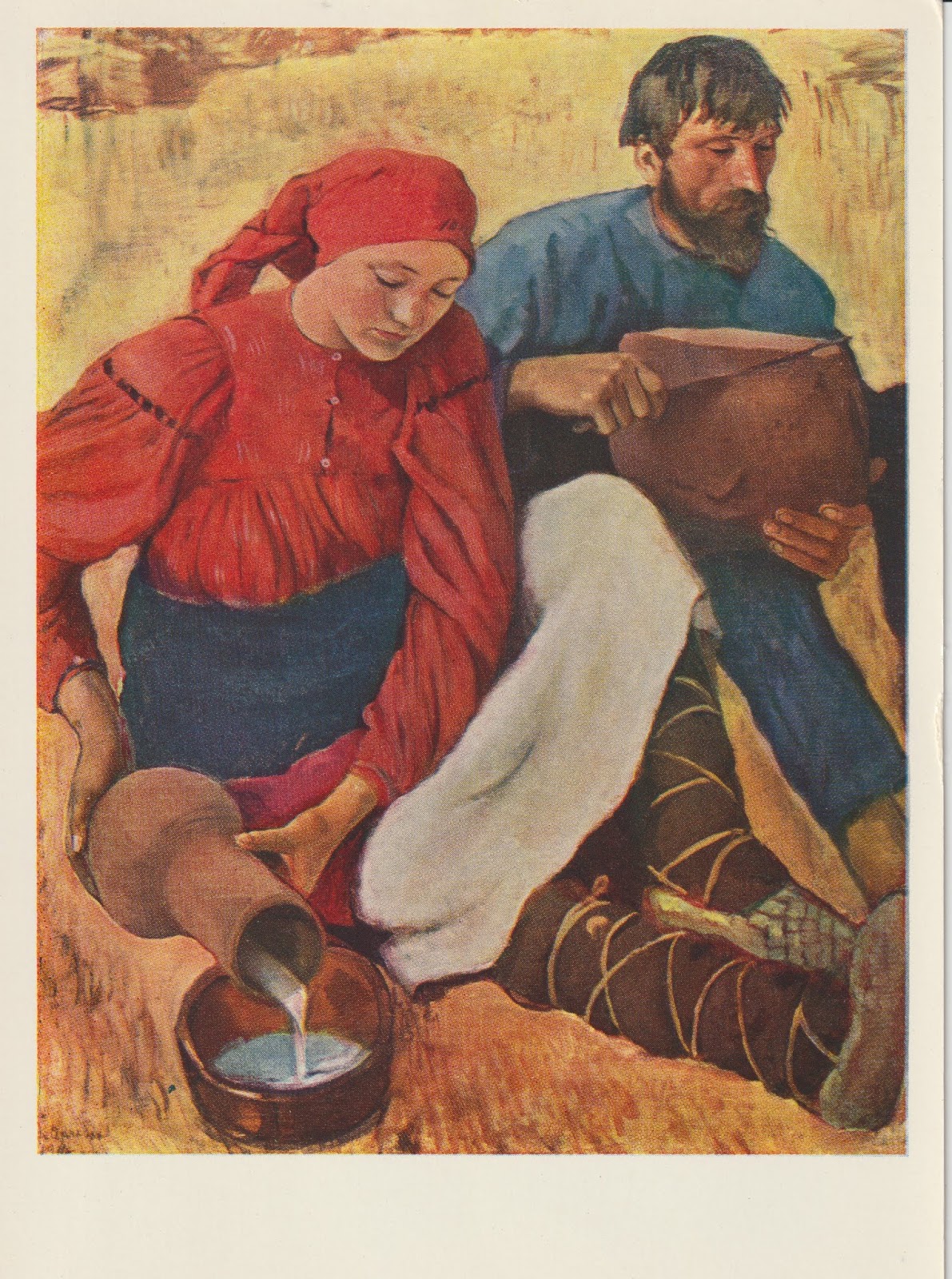
 Peasants, oil painting by Zinaida Serebriakova, 1914

This unused postcard is an Aurora Art Publishers product printed in the USSR.  The 1914 painting, titled “Peasants,” is by a Russian and later French painter named Zinaida Serebriakova.   On the reverse at the upper left corner is the title of the painting and the artist’s name and birth year, 1884.  Since she died in 1967 and no death date is given on the card, the card must have been produced prior to 1967.  The original oil painting measures 38 X 48 inches or 123. 5 X 98 cm and is in the Russian Museum.

Zinaida Yevgenyevna Lanceray was born in 1884 on the Neskuchnoye estate near what is now Kharkiv, Ukraine.  A member of the artistic Benois family, her grandfather was a famous architect, an uncle a famous painter, her father, Yevgeny Nikolayevich Lanceray, was a well-known sculptor, and one brother was an architect, the other brother was a master of monumental painting and graphic art.  

After Zinaida graduated from the equivalent of a high school she entered an art school where she studied under the Russian realist painter, Ilya Yefimovich Repin, in 1901 and under another Russian realist, the portrait artist, Osip Braz, between 1903 and 1905.  She also studied art at the Académie de la Grande Chaumière in Paris from 1905 to 1906.  In 1905 she married her first cousin, Boris Serebriakov.  They had four children, two girls and two boys. 

Public recognition of her works came in 1909/1910 when a self-portrait, titled “At the Dressing Table,” was one among those featured at a large exhibition mounted by the Union of Russian Artists in 1910.  The painting on the card was one in a series of works with the theme of peasants and the Russian countryside completed between 1914 and 1917 when she was considered to be in her prime as an artist.

The October 1917 Revolution brought a huge change to her life.  The family estate was plundered and all the family reserves gone.  She and her family suffered from hunger and she had to give up oil painting for less expensive techniques such as charcoal and pencil.  In 1919 her husband died of typhus contracted while he was imprisoned in Bolshevik jails in Siberia.  She moved to her grandfather’s private apartment in Petrograd.  Then due to the results of the Revolution was forced to share the accommodations.  Fortunately she was quartered with artists from the Moscow Art Theater.  During that time her artwork focused on theater life including ballet.  About the same time her daughter, Tatiana, entered the academy of ballet.  In 1924 Zinaida moved to Paris was commissioned to work on a large decorative mural.  Her children remained with her mother in Russia.  Once the mural was completed she intended to return to Russia but was unable to do so.  She was able to send for her two younger children but could not do so for the two older children who remained in Russia.  It was many years before they saw each other again.  

Fascinated by landscapes and people, Zinaida traveled a great deal.  She also experienced poverty for most of the rest of her life.  She became a French citizen in 1947 and was able to see her older children 36 years after their forced separation.  In 1966 she finally had an exhibition of her works in the Soviet Union in Moscow, Leningrad and Kiev.  Although many of her works were shown in the Soviet Union most remain in France.  She died in 1967 and is buried in the Russian cemetery at Sainte-Geneviève-des-Bois, Paris, France.  Today her paintings are worth much more than when she was alive.

Every once and awhile I am drawn to postcards with artwork.  This one was in a jumble of cards stuffed in a shoe-box at an antique mall.  The bright colors and the peasants having a simple meal, appealed to me.  It was fun to find out something about the artist and her life too.

For additional information, see:

https://en.wikipedia.org/wiki/Zinaida_Serebriakova
https://en.wikipedia.org/wiki/Ilya_Repin
https://en.wikipedia.org/wiki/Osip_Braz
https://moscsp.ru/en/biografiya-zinaidy-evgenevny-serebryakovoi-hudozhnik-zinaida.html

Thursday, June 4, 2020

If this is Thursday it must be postcards, 454


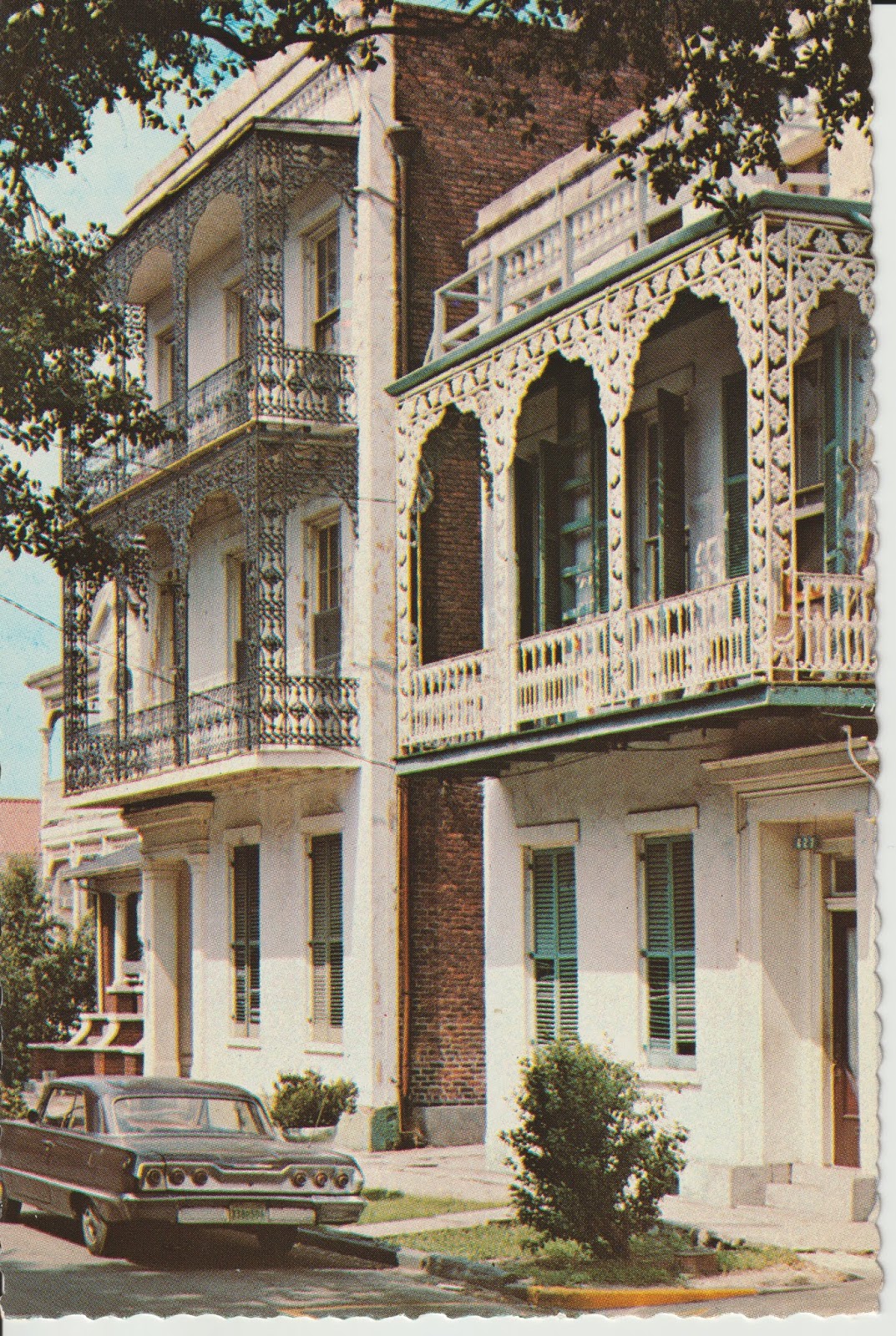
 Antebellum homes, New Orleans, Louisana, ca 1970s

This Grant L. Robertson photograph on an unused postcard from the 1970s has examples of cast-iron work on two balconies and found throughout the French Quarter in New Orleans, Louisiana.  The card was published by the photographer in Metaire, Louisiana, and produced as a Mirro-Krome card by H.S. Crocker Co. Inc., of San Bruno, California. It has GLR-C-455 as the identifying code at the upper middle on the reverse. 

The buildings, found in New Orleans, Louisiana, and shown in the picture are described as antebellum homes.  The antebellum style was found from the American Revolution to the start of the American Civil War.  However, most are from approximately 1820 to 1860.  Plantation homes in the Deep South are also called antebellum although they look different from these and are mostly known for huge pillars and balconies that run along the entire outside edge of the house and create a shaded porch with a sitting area and not so much for the cast iron work. 

Founded by Jean-Baptiste Le Moyne  de Bienville in 1718, the French Quarter, also called The Quarter, Vieux Carré and Barrio Francés, is the oldest section in New Orleans.  It is one of the main tourist attractions in New Orleans.  Fortunately it is built on higher ground that other parts of the city, closer to higher and stronger levees on the Mississippi, and therefore suffered little damage during Hurricane Katrina in 2005. 

A blacksmith, using an anvil, forges wrought iron but cast iron is produced in a furnace and poured into molds.  After the iron cools the sand from the mold is cleaned off and the finished product is ready to be used as decorative railings, banisters, balconies, garden furniture and even plates for stoves.  Also since more manual labor was needed for wrought iron items, cast iron would have been less expensive.  


In the photograph one balcony has been left "natural" or painted black while the second one is painted white.  Both have a lace-like quality and are typical of the homes found in this area.  The car in the foreground provides an approximation of the date.

For additional information, see:

https://en.wikipedia.org/wiki/Antebellum_architecture
https://en.wikipedia.org/wiki/French_Quarter
https://en.wikipedia.org/wiki/Ironwork

Thursday, May 28, 2020

If this is Thursday it must be postcards, 453


Chautauqua Hotel, 1903, New York


The other day I was looking for something in my grandmother’s (Lil Anna’s) old photo album and unexpectedly came across this postcard of the Chautauqua Hotel (New York State) identified and dated on the photo at the lower left and middle.  The card is pasted in the album and as it resisted removal and I did not want to damage it, the reverse side remains somewhat a mystery.  Since this was during the period when postcards had undivided backs and therefore only the name and address could be on one side any message would have appeared across the photo.

When Anna left Norway in 1902 she traveled with a ticket paid for by a sponsor family living in Buffalo, New York, which is not too far away from Lake Chautauqua.  Their name and address was printed on a card and pinned to her coat while she waited at Ellis Island to go through immigration.  She described feeling like a parcel post package waiting to be delivered.  This was a fairly common way for young people to be able to travel to American.  Boys would end up usually doing farm work and girls did mostly housework or tended children.  In 1907 when Anna returned to Norway on a visit she began encouraging friends and relatives to come to America.  She became a sponsor and paid for the tickets, when the ticket was paid off she turned it around and sent for the next person.  Axel and Anna even had a small house on their Lake Union property where the newly arrived immigrant could live until he or she got a job and could be on their own. 

While in Buffalo, Anna worked for the sponsor family for 2 years to pay off the passage fare and save some money so she could go to a young ladies finishing school in New York.  Unfortunately, she did not include the name of the family in her journal.  Later she worked in the garment industry sewing clothing before going to Boston, Massachusetts to live with her brother, John, and his wife, Lydia for a short period of time and eventually traveling by rail across the country to Seattle in time to visit the Alaska-Yukon-Pacific Expo in 1909.  She married Axel Schroder in Seattle in 1912.


Anna Hornnes Schroder, 1912

Lake Chautauqua is about 17 miles or 27 km long and 2 miles or 3.2 km wide with a maximum depth of 78 ft or 24 m.  Buffalo is on Lake Erie and Chautauqua is not far from Lake Erie.  The name of the county and the lake come from the language of the Erie people who lived in this area.  The Erie language is now extinct.  The lake is used for boating, fishing and tourism.  There are many shops, restaurants and entertainment.  There is also a stern-wheeler replica, the Chautuaqua Belle, that offers sight-seeing cruises on the lake. 

Since it is a souvenir card, and more than likely purchased while on a vacation, it seems likely that sometime during the 2 years Anna worked for the family in Buffalo they took a trip to the lake and that is how the card came to be pasted in her photo album.

For additional information, see:

https://en.wikipedia.org/wiki/Chautauqua_Lake

Thursday, May 21, 2020

If this is Thursday it must be postcards, 452


Shakespeare’s birthplace, Stratford-upon-Avon, Warwickshire, England

Today’s postcard is a product of the J Salmon Ltd printing and publishing firm of Kent, England.  Sadly, the company that was founded in 1880 and known as the oldest established postcard and calendar publisher in Britain is no longer in existence.  The card is unused and has the number code:  1-26-01-61 at the lower left corner on the reverse side.  As the title printed on the front of the card says, the photograph is of Shakespeare’s birthplace. 

Joseph Salmon was a London bookseller who bought a stationer’s store in 1880 with the idea of establishing a printing business in Kent, England.  In 1898 he transferred the control of the company to his son, also named Joseph.  Fifth generation brothers, Harry and Charles Salmon, last managed the private family owned and operated company.  They stopped printing and sold the remaining stock in 2018 citing that due to changing habits and technology the demand for postcards had dropped.  Facebook and Instagram having made postcards all but redundant in a decade.


The logo for J Salmon Ltd is, not surprisingly, a salmon!

Shakespeare’s house has been restored and is now a popular, small museum open to the public managed by the Shakespeare Birthplace Trust.  It is believed that Shakespeare born in 1564 and spent his childhood years here.  It would have been considered quite a substantial home for the time but today it is seen as relatively simple.  The house was originally divided into two parts to allow Shakespeare’s father, John, to carry out his business as a glove maker and wool dealer from the premises.  It is half-timber with wattle and daub on a wooden frame.  Local oak and blue-grey stone were used in the construction with the large fireplaces made of brick and stone.  The ground level has stone-flagged floors.  Rectangular in shape the ground floor had a parlor with fireplace, a large open hearth, and a hallway, cross passage and a room that served as John’s workshop.  Upstairs was basically the same configuration with three chambers accessed by a staircase from the hall.  At a later date a single-bay house, known as Joan Hart’s Cottage, was built onto the northwest end and a kitchen was added at the rear with a chamber above it.

At the death of his father, William took over the ownership of the house.  Since he already owned New Place in Stratford and didn’t need the Henley Street house he leased it out.  It was converted into an inn called the Maidenhead and later the Swan and Maidenhead Inn.  Shakespeare’s widowed sister, Joan Hart, occupied the small one-bay house that had been added.  When William passed away the whole property passed to his daughter, Susanna and from her to her only child, Elizabeth and finally to Thomas Hart the descendant of Joan.  The Harts retained ownership until 1806 when it was sold.  Once the family line came to an end, the house fell into disrepair until there was an interest in it as Shakespeare’s birthplace.  A reconstruction project between 1857 and 1864 removed brickwork that had been placed over the timber framed house to restore the outside to its 16th century state.  Flowers and herbs that would have known in Shakespeare’s time have been planted in the walled garden area. 

Trivia:  Several notable persons, like Isaac Watts, Charles Dickens, Sir Walter Scott, and Thomas Carlyle, who visited the house autographed the walls and windows and some of those remain on the windowpanes.   The guest book contains the signatures of Lord Byron, Alfred, Lord Tennyson, John Keats, and William Thackery.

For additional information, see:

https://en.wikipedia.org/wiki/Shakespeare’s_Birthplace
https://en.wikipedia.org/wiki/J_Salmon_Ltd
https://www.theguardian.com/artanddesign/shortcuts/2017/sep/25/postcards-demise-britains-oldest-publisher-industry-death
http://www.jsalmon.com/aboutus.htm