Saturday, February 18, 2012

G day 2


We are all so tired . . .


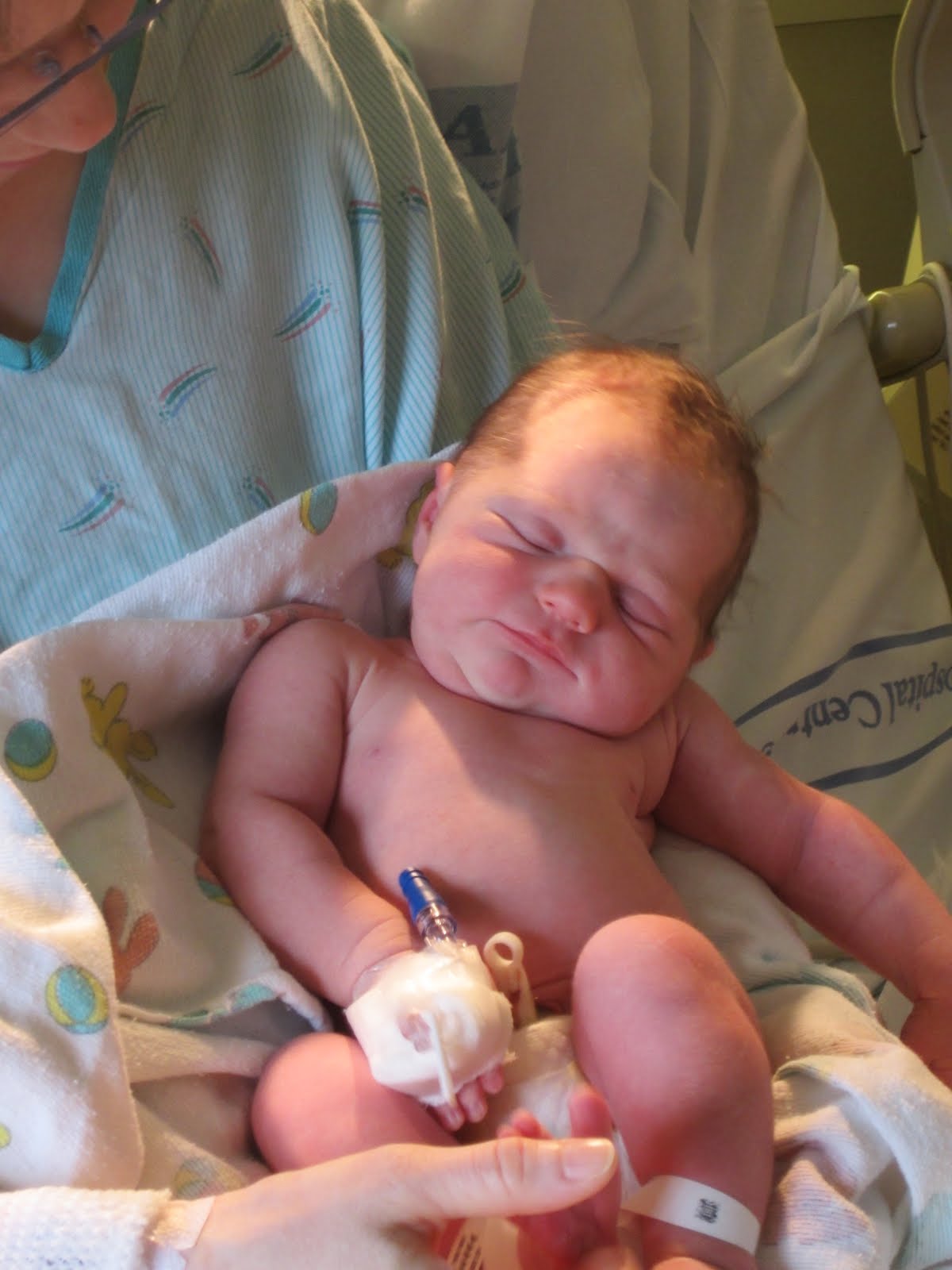
Some of you have been asking for more pictures. Yesterday both Curly and Bee needed breaks and sleep but I don't know how much they got even though I went down to the hospital and held the baby pretty much all day. It was such a hardship! Not. I would happily do it again today but Curly's parents should be there by now. I had my time yesterday and will have more time later. G is a beautiful, sweet baby.

Here are a couple more pictures from yesterday (day 2).

Things are looking a little better . . .


Curly, Bee & G

New dad with his tiny baby girl
.....................................................................................
Note:

This labor & delivery story is unbelievable. Too long, too many unexpected complications. Things like this are not supposed to happen in 2012! In case you have wondered about the bandage on G's hand it is an IV connection for antibiotics. Day 2 had some (not expected nor welcome) complications too but things are generally much better and getting still better.

Thursday, February 16, 2012

G gallery day 1


G says hello to the world today

Today a new grandchild arrived. Just a few pictures for aunts, uncles, cousins & friends . . .

Sweet


Aunt Heather gets to hold her while her Papa looks onNew Mama and babe


Open your eyes, please


That's the way
Hello baby, G

If this is Thursday it must be postcards, 26


Voss, Tvindefos, Hordaland, Norway, ca 1900

This postcard is another from Axel Eliasson printed around 1900 in Stockholm, Sweden. It shows a small mountain cabin or hytte at Tvindefos near Voss, Hordaland, Norway with a magnificent waterfall in the background. The girl stands with her milk pail at the doorway. The fenced area could be for goats or perhaps a small kitchen garden. This is near where Petra and Maggie Landaas tended goats and sheep during the summers when they were girls. It is also near where John and Lydia Hornnes lived at the time of the census before they left for America.

Even today many people still have small mountain cabins. These cabins typically do not have running water or electricity. They are small (suitable for 2 to 4 people) and not easily accessible. Eldbjørg and Hans Lefdal sent some photos of their hytte, which is located in the mountains above the main farm at Lefdal in More og Romsdal in western Norway north of Bergen and Voss. It takes 20 minutes by tractor or 45 minutes walking to reach the cabin.
Eldbjørg is a descendant of Mikal Alfsen and his first wife, Ragnhild Nottosdatter Hornnes. Her brother, Bjarne Nordbu, had the farm Lunnen until his recent death. That farm has now been sold but Eldbjørg still owns the smaller red house located near the church in Hornnes where her mother lived. She and her family visit regularly and it does have modern conveniences unlike the mountain cabin.

Hytte or mountain cabin near Lefdal
[photo courtesy of Eldbjørg Lefdal]


Tractor transportation to Lefdal cabin
[photo courtesy of Eldbjørg Lefdal]


Lunch for four at the cabin
[photo courtesy of Eldbjørg Lefdal]

Notice the kerosene or gas lantern hanging from the ceiling and the candles on the table. I like the pine paneling too. My father made a children's playhouse when I was a girl and the inside looked very much like this. That playhouse was probably about this same size and did not have running water but it did have electricity.


Voss

Here is another view of cabins near Voss from the 1900 era. They look about the same size as the cabin at Lefdal but not quite as comfortable. The scenery is beautiful but the bridge looks a little scary not to mention the mode of transportation used at that time. Instead of the modern tractor pictured above one would have to ride in a cart similar to this shown on another Eliasson card from about 1900.


Transportation mode of early 1900

The stretch of road on the card at least has a guard rail. Many of the roads in the mountains are extremely narrow with turnouts for oncoming traffic but no guard rails, just straight down the mountainside hundreds of feet. I'm sure I would prefer the modern tractor and a wider road!

Wednesday, February 15, 2012

John Mikalsen Hornnes


John Mikalsen Hornnes, ca 1895
[photo courtesy of Alf Georg Kjetså]

The seventh child of Mikal Alfsen and Anne Gundersdatter was John Mikalsen Hornnes. John was born 23 July l874 when his father was 69 years old and still working the farm Lunnen at Evje og Hornnes, Aust Agder, Norway. He was almost 16 years old when his father died in 1890. I think he had what might be termed a “hard life.” He worked at all sorts of different jobs probably beginning from about the time he was 14 or 15. As a younger son in a second family he had little hope of inheriting anything that might have given him a boost starting his own life and family. He worked on farms, in the mines, and finally for the railway line. Working for the railroad appears to have provided the steadiest employment but it meant moving frequently. We find him living in Aust Agder, Vest Agder, Rogaland, and Hordaland. All located in southern Norway but at a distance from the rest of his family who stayed mainly in either Aust or Vest Agder.


John & Lydia Hornnes, ca 1900
[photo courtesy of Alf Georg Kjetså]

John met Lydia Gabrielsdatter Marstad while he was working on the railroad. She was born 23 April 1876 in Hitterø, Vest Agder the daughter of Gabriel Sivertsen Marstad and Olene Elisabeth Olsdatter. They married in Flekkefjord, Hidra, Vest Agder on 5 April 1899 and then moved first to Aarestad, Helland, Rogaland and then shortly after to Voss in Hordaland where they were living at the Føderaadhus at Lassehaugen the time of the 1900 census. While they were in Aarestad their only child a son, Mikal Alfred, was born 2 June 1900 and died the same year probably very shortly after birth. I think the Føderaadhus was some sort of residence mainly for railway workers as there are many of them and their families living at the same place for the census.

In 1901 John and Lydia left Norway for America intending to settle in the farmlands of Minnesota. We know that John’s uncle Torkel and some of John’s cousins were either already living in Minnesota or would soon be, therefore, the couple had family to be close to when they arrived. However, Lydia became ill with tuberculosis and they decided to move to Boston, Massachusetts to be closer to her sister. John and Lydia were living in a suburb of Boston called Melrose when Lil Anna arrived in America a year later. They provided her with a place to live and she was able to help them a little by paying for her room and board.

By the time Sadie and Anna Stean and Gunnie Osmun arrived in America around 1908 it was obvious that Lydia was seriously ill and not expected to survive the disease. She died not too long afterwards. John was devastated. Following her death he worked mostly as a day laborer moving from here to there. He began drinking. He came west and spent some time in Seattle then moved north to Alaska. Eventually he ended up in Seattle where he lived in hotels. He never remarried. He died 4 April 1943 in a fire thought to have been started as a result of smoking in bed while drunk. A tragic end to a man who had a difficult life.

Thursday, February 9, 2012

If this is Thursday it must be postcards, 25


Bandstand, 1909

Music played an important part in most activities of the early 1900s especially at events such as the 1909 Alaska Yukon Pacific Exposition. There were several songs written and performed just for the Fair including a grand triumphal march and another favorite march entitled “Gloria, Washington” composed by Frederick N. Innes. There were various songs like “Won’t You Stroll With Me on the Pay-Streak?” “Meet Me in Seattle, Dearie, in 1909,” “Hip Hip Hurrah for Seattle,” “The Seattle Spirit,” and others. No CDs for sale but the songs were printed up then made available for purchase by Fair attendees who could then go home play the piano, guitar, "squeeze box," or fiddle and sing along.

Looking north on Pacific Avenue showing Forestry Building & Bandstand, 1909

Several structures that were smaller than the big buildings were scattered here and there on the grounds. One of these was the Bandstand. It was located in front of the imposing Forestry Building. In the postcard above it is just barely visible on the upper left side of the card. The card shows a couple of other small structures. The white kiosk in the center of the card contained a display by the Paraffine Paint Company. Other small not-quite buildings were used as lemonade stands, peanut vendors, what might be termed fast food stalls and small entertainment venues that often included some live music.

Forestry Building and Bandstand, 1909

Outdoor music concerts and other community activities are still held in Seattle during the summer months at selected parks in the city. So even though we have entered the 21st century we are still carrying on some of the traditions of the 1909 Exposition.

For more information see:
http://www.historylink.com http://www.lib.washington.edu/specialcollections/collections/exhibits/ayp

Monday, February 6, 2012

Winter afternoon with the ducks


Ducks just off the east point of Union Bay


Saturday I noticed a post in one of the local neighborhood blogs concerning the sightings of a rare Tudu Eurasian tufted duck in the water near the wetlands by the Urban Horticultural Center at Union Bay. The duck was seen on Friday and then again on Saturday when the notice appeared in the Wedgewood blog. For a picture of the Tudu, please see http://www.wedgwoodview.com/

I texted Mrs. Gimlet since we had about an hour before sunset and Union Bay is close. We decided to go. The duck was supposed to be swimming off the east point of the Montlake fill (Union Bay) so it would be easy to park at the Urban Horticultural Center and walk a little way to the lake. The blog said all we would have to do once there was to find the group of birders and blend in. We tried. There were a few people clustered along the shoreline with binoculars, tripods and cameras but the duck was either gone for the day or out so far in the lake we couldn’t get a look at him. We had neglected to bring binoculars (silly us) and even Mrs. G’s fancy telephoto lens was not quite big enough to zoom in on the “barge” of ducks out in the lake. I'm not sure "barge" is the correct term but that is what it looked like. It was a pretty good test for my new little digital camera. Sadly it does not have the zoom lens capacity that my big, heavy old EOS Canon film camera does but it does take good photos. I did over hear someone mention that the duck had been away from the main group but even so it would have been very difficult to pick him out.

To make matters worse a clueless Kayaker paddled by sending the ducks and coots quacking, hooting and flying then resettling even further out in the bay. We stayed until the sun started setting and then left intending to come back with binoculars in the next day or two if the weather held. But today is Monday and we haven’t gone back yet.

In addition to the normal group of Mallards and coots there were Widgeons, Golden eyes, Mergansers, and a few geese. The sign at the beginning of the trail said a swan had been sighted earlier. We will walk down there again even if there is no hope of seeing the elusive Tudu since it is quite a pretty place and a very nice walk on a sunny day.


“Barge” of ducks and coots moving further out into the bay.


The Mountain is out!


Part of the wetlands trail

We heard lots of Red-wing blackbirds but didn’t see any. There were crows but we didn’t see many of those either just the few in the sky of this picture. Right around sunset the crows often fly to a common roosting area. It is quite the experience to see them, hundreds it seems, flying together and making such a racket.

Robin taking a rest on the porch

I had to come home to see a bird close up enough to get a picture with my new camera. Just a robin but made me feel that winter may be turning a corner toward Spring.

Thursday, February 2, 2012

If this is Thursday it must be postcards, 24


Little girl in Hardanger bunad, ca 1900s
[Mittet & Co. No 6]

Postcards reached the height of their popularity in the early 1900s when they were a preferred method of sending short messages with the added bonus of a picture. Publishing companies branched out and added postcards to their selections. The company that printed this card, Mittet & Company A/S of Oslo, Norway, was established in 1899 by Ingebrigt Mittet and developed by his two sons Knut and Søren Mittet. They published children’s books and other items but are best known as the most productive postcard publisher in Norway printing a wide variety of cards. The Norwegian National Archives have 265 negatives from this company most on glass plates. Themes for the cards range from the Norwegian royal family, churches, Oslo, Arkerhus fortress, parades on “Help the Children’s Day” in 1906 and others. The glass plates were the basis for the postcards from 1905 to 1930. For more information about Mittet & Co. please see the Norwegian archives site at http://www.arkivverket.no/eng.

Since this card is of a child I did wonder if it might have been associated with the Help the Children’s Day. The postmark on the reverse of the card is not clear enough to read the date but there is a Roman numeral VI in the middle of the stamp.
Mrs. Gimlet was delighted to see the detail on this postcard but somewhat horrified to see this little girl with the Hardanger lace in her mouth! And in truth, the reason the card attracted me to it in the first place was the detail of the lace embroidery on the apron as much as the cute little girl. It takes hours and hours of the most painstakingly meticulous work to do this type of embroidery and cutwork. Here is an example of Mrs. Gimlet’s handwork for the baby gown she is currently making for her newest little niece or nephew expected in this month. Curly’s mother and Curly will make the dress itself using the pieces Mrs. Gimlet has embroidered. Then later, in September, Mrs. G hopes to enter the finished product in the needlework competition at the Puyallup Fair. This is an heirloom in the making!

The collar section of the blessing gown
[photo courtesy of Heather Laurence]

I thought I would share a couple of family stories from the Landaas family. This family lived in the Hardanger area of Norway. All the girls had the silver sølje pins and some of them had the local bunad as well. Two examples of the pins are shown below. The pin on the top is modern the small pin on the bottom is old, probably about 125 years old, and is handmade. Both pins are silver with the top pin all silver while the smaller pin has brass spoons. The measuring tape is there to provide an idea of the sizes. The smaller pin would typically have been used on a child’s costume. If you look closely at the postcard you will see that this little girl is wearing a rather large pin that is attached to the blouse but hangs down into the vest.


Sølje

The Landaas family lived most of the year in the city of Bergen where the father, Peder Landaas, worked as a carpenter and woodcarver. I believe he also did some cabinetry work. Peder’s parents lived north of Bergen at a farm called Fiskeset. During the summer months the children and possibly their mother went up to the farm where they could help the grandparents. The two oldest Landaas girls, Mikkeline (Maggie) and Petra usually had the job of tending the sheep and goats up on the mountainside. Maggie loved the outdoors and the farm in general and thought it much better than living in the city. Petra on the other hand preferred living in the city and was not overly fond of going up to the farm. These girls were tiny. Even as an adult Petra never reached 5 feet in height and was quite slender when she was a girl. Taking care of the ewes, lambs, kids and nanny goats wasn’t too bad but there was at least one nasty ram that gave the girls quite a bit of trouble.

One of the stories Petra would tell was about the ram and how he would run at her and her sister and butt them hard enough to send them sprawling on the ground. He was a fearsome creature from her description with huge horns. One day he came at her and instead of walking away after tossing her down on the ground he kept coming back to ram her again and again. She did not know what to do to get away from him but she was on a steep hillside so she rolled up into a ball and went somersaulting down the mountain to escape.

Another memory she had of her summer stays at the farm was the year she had a very bad cold. It sounded almost more like pneumonia or the flu than a cold the way she told it. At any rate her nose was stuffed up for possibly weeks and finally her mother and grandmother had had enough of it and tarred the inside of her nose to get it to stop running and dripping. The cure was effective as far as the drippy nose went but it cost her the sense of smell. She said this happened in early summer and the last thing she recalled being able to smell was ripe strawberries growing on the mountainside. Ever after it was a big inside joke when she was asked what she would like as a gift she would smile and say perfume and then laugh.

Petra and Marjorie Lee with some chickens, ca 1920

I can never remember a time when my grandmother, Petra, was not dressed up so it is almost impossible to think of her on that farm in Norway. Here she is with my mother and some chickens and even then you will notice that she is wearing white shoes and jewelry!