Thursday, August 7, 2014

If this is Thursday it must be postcards, 154


 Osberg Viking ship built ca 800-820 AD

The photograph on the postcard above showing the Osberg ship being transported through the streets of Oslo, Norway was taken in 1926.  This ship was a burial ship and one of three ships on display at the Viking Ship Museum in Bygdøy a short boat ride from the Oslo harbor.  The Norwegian Haakon Shetelig and the Swedish Gabriel Gustafson, archeologists, excavated the ship in 1904-1905 from a burial mound at the Osberg farm near Tønsberg in Vestfold.  At that time they also found numerous other grave goods plus two female skeletons that had been laid out in a bed, the skeletons of 14 horses, 3 dogs and an ox.  It is thought that one of the women might be Queen Åsa of the Yngling clan, mother of Halfdan the Black and grandmother of Harald Fairhair and the younger woman perhaps a maid servant or daughter. 

Parts of the ship date from around 800-820 but the grave itself has been dated 834.  Built almost entirely of oak it measures approximately 71 feet long (21.58 meters) and 16 feet wide (5.10 meters).  Thirty people rowed the ship placed in two lines of 15 oars each.  The design of this ship suggests that it was used for coastal voyages rather than ocean travel. 

The postcard below shows a photo taken in 1904 with some of the fine carved detail work on the ship. 


Detail of carving on the Osberg ship

Another ship at the Viking Museum is the Gokstad.  It was discovered in a burial mound at Gokstad farm in Sandar, Sandefjord, Vestfold and has been dated to approximately 890.  There had been legends about the hill called Gokstadhaugen or Kongshaugen (kings mound) on the farm where it was discovered. In 1880 the farmer living there started digging around in the frozen earth to see what might be under the ground.  When he uncovered the bow of a boat the word got out and the Society for Preservation of Ancient Norwegian Monuments stopped the exploration until a team could officially excavate.  The farmer had started digging down from the top the team led by Nicolay Nicolaysen began from the side finding the ship after only two days. 


Gokstad ship built ca 890 AD

Unlike the Osberg ship this one was used for warfare, trade, transportation of people and cargo and the design is shown to be seaworthy (ocean going).  It is made primarily of oak is 76.2 feet long (23.24 meters) and 17.1 feet wide (5.20 meters).  It had a crew of 40 including 32 oarsmen but could hold as many as 70 people.   It was also used as a burial ship and contained a male skeleton inside a timber-built chamber.  It is not known for sure who the man was but some think it might be a petty king, Olaf Geirstad-Alf from Vestfold.  He was also from the House of Yngling and died about the correct time for this to be so.  There were some graves goods as well that are on display at the museum; however, it is believed that the mound had been plundered in ancient times as expected valuables made of gold and silver had been removed.  Weapons important during this time were also missing so it is supposed that grave robbers probably took them too.  


Tune ship built ca 900 AD

The third ship seen above is called the Tune ship and was built around 900.  It is not in as good condition as the other two.  It measures 72 feet long and 14.3 feet wide. with 11 or 12 pairs of oars.  This ship was a fast ocean going vessel.  It was found in a boat burial mound at Haugen farm in Rolsvøy in Tune, Østfold and excavated by the archeologist Oluf Rygh in 1867.   All three ships used sails in addition to oars.

We had just one day in Oslo so we knew it would only be possible to see a limited numbered of things.  Since both the Folk Museum and the Viking Ship Museum, which we wanted very much to visit, were located on Bygdøy and the trip over to the island would also give us a nice sightseeing boat ride that made the decision easy.  If we had more time when we returned we could chose something else closer to our hotel. 

Here below are a few pictures from our visit to the Viking Ship Museum.  When I visited here in the 1980s it was forbidden to take flash pictures.  Now with the newer digital cameras that do not need so much light it is possible to get good pictures even without flash.
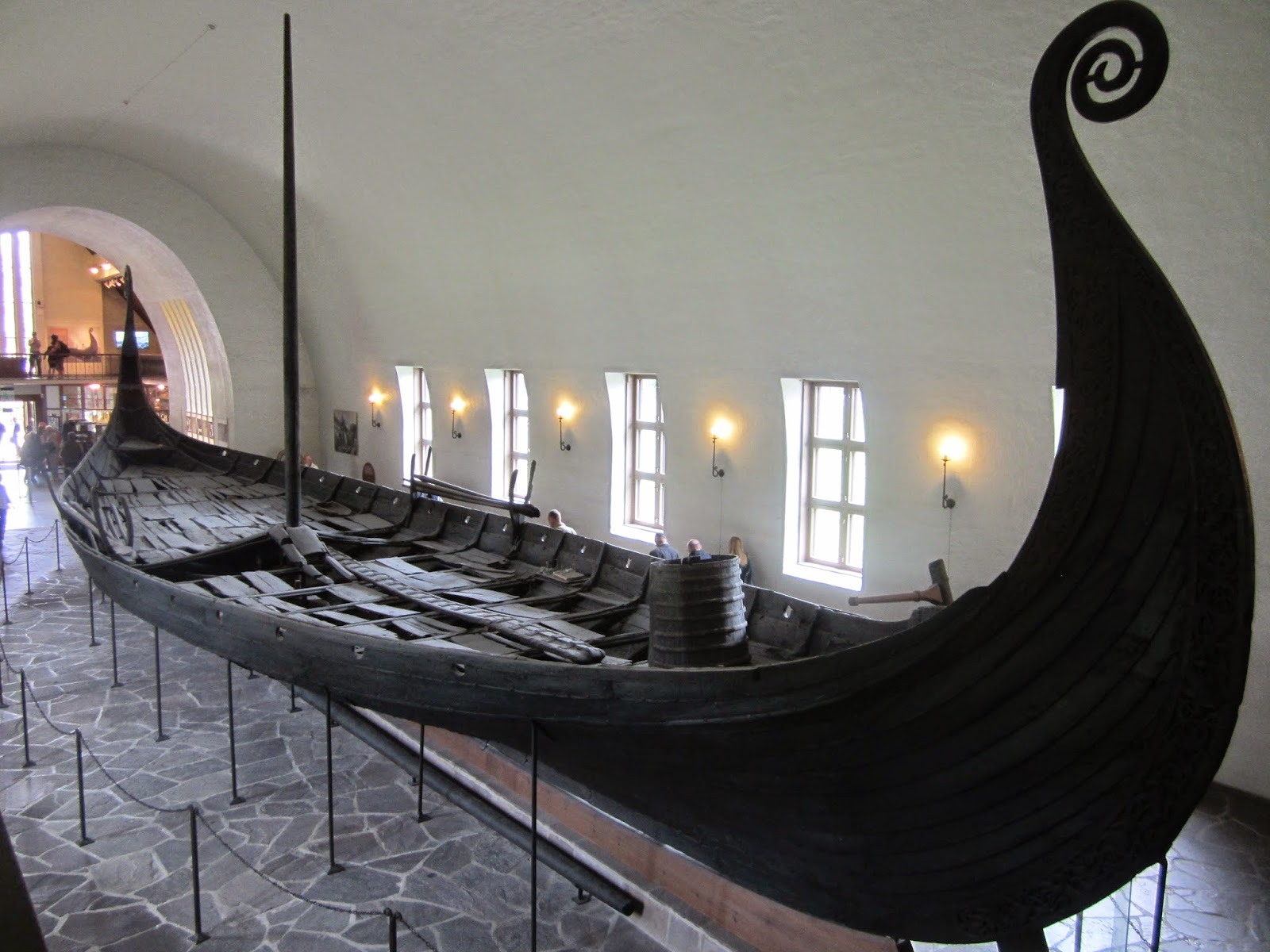


The three photos above are of the Osberg ship. 


Gokstad ship

One of three elaborate sleds found with the Osberg ship


Animal-head post

Above are two other artifacts found at the same time.  The sled has intricate carvings, as does the animal-head on the ornamental post.


These two smaller boats, lifeboats or tenders, are from the Gokstad grave.  A portion of the wooden burial chamber is at the left side. 


For additional information, please see:


http://en.wikipedia.org/wiki/Oseberg_Ship
http://en.wikipedia.org/wiki/Viking_Ship_Museum_%28Oslo%29
http://en.wikipedia.org/wiki/Gokstad_ship
http://en.wikipedia.org/wiki/Tune_ship

Sunday, August 3, 2014

Naches Peak Loop


Mt. Rainier

The naturalist class we are taking through the Mountaineers consists of four lectures and four field trips.  Our final field trip yesterday was at the Naches Peak Loop trail, partially in the Rainier National Park and partially in the William O. Douglas Wilderness.  The trailhead is on Highway 410 at the summit of Chinook Pass, elevation 5400 feet.  The hike took us up to 5800 feet and back down. 


The first small lake or pond we came to where there was a salamander

The 4-mile round trip winds up through meadows filled with a profusion of glorious wildflowers at this time of year.   The trail passes by 5 little lakes, has views of the larger Dewey Lake as well as glimpses of Mt. Rainier and Mt. Adams.   As sometimes happens in the mountains we had interesting weather during the day, everything from thunder and lightning, hail, sleet, rain, and clouds to bright sunshine with lots of heat.  Two weeks earlier there had been snow on much of the trail.  This day we encountered a snowfield of about 100 feet across just above the trail and saw several children playing in the snow.  Unfortunately, there were hordes of bugs all along the loop so even though I liberally applied bug repellent I am still suffering from mosquito bites today. 

This was a smaller group than the other field trips making it easier to gather around to listen to the leader explain about the things we are learning to recognize and identify.  


It is a popular trail and was a Saturday equaling lots of people enjoying the outdoors so our small class group going along slowly looking at things was often passed and sometimes joined for a little ways by the curious.  


Dewey Lake, seen in the photo above, is the largest of the lakes along this route.  This was taken looking back from the upper trail.


Magenta Paintbrush, Lupine, Arnica, Valerian, Bistort


Avalanche Lilies


The two flowers I had most hoped to see were Avalanche Lilies and Bear Grass.  The unusual four lilies on one stem seen above was a special treat.  We did see hillsides filled with these delicate small lilies.


The Magenta Paintbrush ranged from deep intense color to paler pink and one was white.


Corn Lilies also known as Green False Hellebore.  These can get quite tall, 3 to 7 feet.


Columbine


Pink Heather, Magenta Paintbrush


 Mop Heads (Pasque Flower) 


Bear Grass


In several places the hillside had been covered in Bear Grass


A chipmunk playing hide-n-seek


Thursday, July 31, 2014

If this is Thursday it must be postcards, 153


As usual I was picking up postcards from almost every place we visited on our recent trip.  The photograph on the postcard above is the view looking down on Geirangerfjord in the Sunnmøre region of Møre og Romsdal, Norway.  We counted ourselves lucky to be able to visit this fjord, one of the most popular tourist destinations in Norway.

Our flight from Seattle took us over the pole to Frankfurt, Germany, then after a few hours layover a smaller plane took us to Bergen, Norway where we spent one night.  The next morning we took a shuttle plane to the small airport that serves Volda, Ørsta and Hovden.  A cousin who had visited me in the United States lives in Ørsta and had invited us to stay with them.  They had places they wanted take us to see and one of them was Geirangerfjord.  We would have to drive a couple of hours north by car from their home, park the car at the small town of Hellesylt and walk on the ferry that would take us up the fjord to Geiranger.   The day we planned to go turned out to be one of the very few times when it rained solidly all day.  Even so the trip was wonderful, the views spectacular, the company delightful and the day a success.

Geirangerfjord extends for a little more than 9 US miles or 15 kilometers and is a branch of the larger Storfjorden or Great Fjord.  The ferry ride was an hour or more of fantastic views, countless waterfalls, steep mountainsides, and tiny little abandoned farms clinging to the slopes.  What with the heavy rain and the snow runoff we probably hit the maximum water flow coming over the falls.  Out of the 100 or so falls we saw and took pictures of there were a few that stood out including a series of waterfalls called the Seven Sisters shown in the photos below.  There were unbelievable torrents cascading over the cliff.  

Across the fjord is another large waterfall called The Suitor.  Legend says that the sisters are dancing playfully down the mountainside and the suitor is flirting and trying to woo them from across the fjord.  Bob loves waterfalls and was delighted with so many to see and photograph.  Even though it was raining he managed to find a small covered place on the ferry deck to stand to take pictures.   The rest of us stayed dry inside enjoying views and taking photos through the windows.


The Seven Sisters waterfalls


A closer look at one of the Seven Sisters


The Suitor


Looking at Geiranger through the ferry window


A large cruise ship
Apparently there are times when several of these large cruise ships are anchored in this bay.  


We are used to the ferries on Puget Sound that have both ends open allowing cars to drive on and off.  Only the front end of this Norwegian ferry opens to let the cars and passengers enter.  After everyone is aboard the ferry turns around and starts the journey to the opposite end of the fjord.

A constant threat is rock slides from the erosion occurring on the mountain Åkerneset.  If a large section of the mountain falls into the fjord it would cause a tsunami and impact nearby towns including Geiranger and Hellesylt.  Another possible threat to this beautiful area is a disputed plan to build power lines across the fjord.   In 2005 Geirangerfjord and Nærøyfjorden were listed as UNESCO World Heritage Sites so it is hoped that it will continue to be protected. 

The postcard below has a map of Norway.  The third picture up from the bottom left is Geirangerfjord.


For more information, please see:

http://en.wikipedia.org/wiki/Geirangerfjord
http://en.wikipedia.org/wiki/Seven_Sisters_Waterfall,_Norway


Thursday, July 24, 2014

If this is Thursday it must be postcards, 152


 The Angelus by Jean François Millet, 1857-59


 Reverse

Some postcards, like this one, have pictures of famous paintings or other familiar works of art.  This beautiful painting called The Angelus (1857-59) is by Jean François Millet who was a French artist born in 1814 and who died at age 60 in 1875.  The original painting changed hands several times and now hangs in the Musée D’Orsay in Paris, France.  The title of the painting comes from the first line in the Angelus prayer.  There is some controversy over whether the man and woman are giving thanks at the end of the day for their harvest or if it was originally a funeral scene with a couple praying for a dead child.  An X-ray of the painting showed a geometric shape like a coffin that was painted over to become the basket holding the potatoes by the woman’s feet.  It is unclear if Millet changed his mind on the meaning of the painting or if the shape was even supposed to be a coffin.  The painting became popular and was reproduced frequently during the 19th and 20th centuries, which may partially explain how it ended up as a postcard image.

Millet was born in the farming community of Gruchy, Gréville-Hague, Normandy, France.  His early education was guided by two village priests who taught him Latin and modern literature.  In 1833 he went to Cherbourg to study portrait painting with Paul Dumouchel and by 1835 he was studying full-time with Lucien T. Langlois.  Langlois and others provided Millet with a stipend that allowed him to move to Paris and study at the École des Beaux-Arts with Paul Delaroche.  Millet was one of several artists who eventually settled in Barbizon and established what came to be called the Barbizon school.  His painting style is known as Realism and his subject matter was often peasant subjects having to do with farming and everyday activities.  Some of his more famous works are “Woman Baking Bread, 1854,” “The Sower, 1850,” “The Gleaners, 1857,” “The Potato Harvest, 1855,” and this one on the card, “The Angelus, 1857-1859.”  During his life his works received mixed reviews and it was not until toward the end of his life that he achieved financial success and increased recognition.  His works are said to have been an important inspiration for Vincent Van Gogh who also produced some paintings of potato farmers. 

An American art collector, Thomas Gold Appleton,  commissioned The Angelus but never collected it.  It is famous today for driving Barbizon artwork prices up to record amounts in the late 19th century.  About 10 years after Millet died The Angelus sold for 800,000 gold francs.  In today’s money it would be at least 10 million dollars.   Due to the difference in the auction prices and the art market  compared to the value of Millet’s estate a French law called “droit de suite” or “right to follow” was passed to compensate artists or their heirs when the work was resold. 


The postcard was published in Germany by Stengel, is unused with a divided back and has a short statement in German about the artist at the bottom left on the reverse.

For additional information about the painting and the prayer, see:

http://en.wikipedia.org/wiki/Jean-Fran%C3%A7ois_Millet
http://en.wikipedia.org/wiki/The_Angelus_%28painting%29
http://www.preces-latinae.org/thesaurus/Cotidiana/Angelus.html
http://www.ourcatholicprayers.com/the-angelus.html

Wednesday, July 23, 2014

Røldal Stave Church, Norway


Røldal Stave Church

There were several goals for the Norway segment of our European trip planned for last year but postponed until this year due to a broken leg.  At the top of the list was visiting with cousins and seeing places where my father’s mother and her family lived.  Also near the top was the desire to visit at least one of the remaining Stave Churches.  Long ago there were 900 or more of these churches all built between 1100 to 1300 but many have burned, been destroyed by time and rot, the lumber reused, or otherwise not sustained leaving only about 28 considered as national treasures.  On this trip we were fortunate to see two of these churches.  One was the Røldal church in Hordaland, Norway that is open to the public and is still used as a church, the other was the Gol Stave Church at the Folk Museum in Oslo.  We stopped at Røldal to visit the church on the trip down the west coast of Norway from Ørsta where a cousin lives to Hornnes in the Setesdal where there are many more cousins.  There will be separate posts about the Folk Museum and the cousins.

The Røldal church was built in 1275 AD toward the end of the time when stave churches were constructed.  Because of this and also because it does not look quite like other stave churches some speculate that it is perhaps a post church instead but today it is listed as one of the remaining stave churches.  Unlike many of the more ornate churches we saw this one is not full of gold gilt but it is covered inside with paintings, designs and pictures.  There have been numerous repairs, renovations and restorations to the Røldal church so it does not look exactly as it did originally. 


Crucifix, ca 1250

This is a Pilgrim church and is located on an old pilgrim route that was used during the Middle Ages.  At some point in time the pilgrimages were discontinued but in 2003 a group of people began to revitalize the pilgrim’s way and since then a pilgrim’s walk takes place each year on July 6 the old Midsummer.  In olden times this church was a place where afflicted persons would come for healing.  Those that were healed made generous donations to the church.  The crucifix shown in the photo above is from approximately 1250.  During the mass on Midsummer Eve the crucifix was said to “sweat” with curing effect. 

There are a few legends about the church and the crucifix that were passed down orally for generations.  Today it is hard to tell what kernel of truth there might be in any of the stories but the fact that they were deemed important enough to pass along seems to suggest something happened here to make this a holy place.  In the beginning there was a controversy about where the church should be built.  Once the site on the south side of the river had been agreed upon the lumber was stacked up ready to begin construction but during the night it moved to the north side.  The people of the community took this sign as a miracle and built the church at the new north site. 

One story about the crucifix says that an old blind man and a young boy were out fishing in the fjord when the line caught on something heavy.  When they pulled the line in they found the crucifix.  It was very heavy and they could not get it into the boat.  After much effort the old man wiped the sweat out of his eyes and had his sight restored.  He realized that it was the crucifix that had caused the healing to occur and he promised to give it to a church.  He named several churches but the crucifix was still too heavy to pull into the boat.  Finally he named Røldal and the crucifix became so light that it almost entered the boat by itself.  The old man and several others then took it to the church and put it up where it is now.   Another legend says that the crucifix was found in the mountains. 

Early pilgrims were convinced that if they could get a little of the sweat from the crucifix and apply it to a sick or crippled person it would cause a healing.  The crucifix was taken down off the wall during the Midsummer Eve service.  Crowds of pilgrims met at the church, many had to wait outside for their turn to take a small cloth and gather a bit of the sweat.  While they waited they would sometimes carve their bumerke or signature mark in the church wall.  Also there were small knotholes that could be opened to allow a view into the chapel so those waiting could see and participate in the service and healings even though there was no room inside for everyone.  The docent told us that since the service was held in the summer it probably got very hot inside the church and moisture collected on the statue to drip off and this was interpreted as the healing sweat. 


Bumerke or signature marks carved on the wall


One of the peepholes

Here are a few more pictures from the interior of the church.  Notice all the beautiful artwork that covers almost every available space.


Several people came into the church to look around while we were visiting.  The docent took extra time to explain things to us.  I am not sure if that was because we were American visitors or if it was because Hans is a retired architect and had shown interest in parts of the building.  For whatever reason we were very grateful and felt like we got special treatment.


The new organ.  The paintings show various saints.


The ceiling


On the wall—the front piece dating from 1340 showing the suffering, death and resurrection of Christ.


The altarpiece painted by Gotfrid Hendtzschell in 1629. 


The soapstone font dates from the 1200s.


Gotfrid Hendzschell also painted the pulpit that was added.  The pulpit was more important in the Lutheran church than when the church was Catholic.  The church was originally a Catholic church that changed to Lutheran following the Reformation.


Decorative pew dividers


Another view of the outside of the church, wall and graveyard

For more information, see:

http://en.wikipedia.org/wiki/R%C3%B8ldal_Stave_Church

Note:

We also purchased a small booklet, "The Røldal Church, Pilgrim Church" published by the Røldal parochial church council 6 July 2008, about the church while we were there that has many of the details shared here.