Wednesday, January 17, 2024

XC Skiing, first day out 2024


The parking lot at Hyak, just east of Snoqualmie Pass summit

Not many cars at Hyak for our first day out XC skiing in 2024.  Maybe it was the 12º F (-11º C) temperature?  We did not go far.  There were strong gusts of wind making it even colder on the way out.  The wind chill factor blowing in our face was probably 0º F ( -17.7º C).  The wind at our back on the return trip was a lot easier to endure.  The snow was packed powder, and the grooming was in very good condition. The downside was that the cold, dry weather made it very slow, sticky, snow.  It is hard to explain, but it makes it impossible to glide very far or at all.  A lot of work to go a short distance. 


I was stuffed into multi-layers, and other than my hands, kept very warm and cozy, but if I had fallen, which I did not, I would have ended up like Charlie Brown in his snow suit and even Snoopy would not have been able to help me get up.  My hands typically get so cold for the first 1/2 hour that I do not want to remove gloves to take pictures while we are out skiing.  I have tried heating them up under the hot air blower in the restroom before starting out, but even that doesn't keep them warm enough.  This time Bob suggested we try switching gloves a couple of times since his hands stay warm.  His warm hands had heated his gloves up nicely.  My gloves are really too small for him, but they have a zipper that provides a little more room.  It goes the other way too, his gloves are really too big for me and make holding the poles a little difficult.  However, it was super nice to slip my icy hands into warm gloves.  Once he got my gloves heated, we switched back again.  By then we had been out long enough that my hands were warming up too.  Might not work for everyone, but it is something we will most likely do again.


This year the ski areas opened a bit later than other years.  Grooming for the XC trail at Hyak just began this past week.  The alpine ski areas opened and started running the chair lifts earlier.  Not all of those areas are open every day.  Bob gets a Sno-Park pass so we can park and XC ski as often as we like all season at several different XC areas instead of paying a daily fee each time we go.  This is a huge savings for us since we try to go once a week.  The fee pays for plowing the lot and the trail grooming. 


It might be a little hard to see, but the wind had made swirling patterns on this patch of snow. 

Even though it was so cold, we had a good outing.  The sun was shining, blue sky with a few clouds, and the trees were flocked with new snow. The Snoqualmie Nordic Club has built a warming hut about 1/3 of a mile ( 1/2 km) from the parking lot.  We saw it on the way out.  On the return trip Bob skied over to see what it was like, but he did not want to take off his skis and go in.  It was still too cold to remove gloves to take photos, so next time we go we may try out the hut and take a picture.  The pictures in this post were taken from inside a nice warm car.


Ski tracks on a small hill near the Summit


The view coming down from the summit


Note:  Today lots of new snow coming down and both Snoqualmie and Stevens Passes are at least partially closed as I am writing this.  Snoqualmie westbound is open, Stevens is closed both directions.

Thursday, January 11, 2024

If this is Thursday it must be postcards, 641


Blackwater Falls, Tucker County, West Virginia


Another unused photo postcard, this one features the main attraction at Blackwater Falls State Park located in the Allegheny Mountains of Tucker County, West Virginia.  No photographer is credited for the picture but there is a blurb at the upper left on the reverse.  The card was distributed by Silver Lake Nursery, Horse Shoe Run, West Virginia.  Both Silver Lake and Horse Shoe Run are unincorporated communities located not far from the Blackwater Falls State Park.  It is likely that the Silver Lake Nursery had picture postcards available for tourists.  This card was found in shoebox jumble of old postcards in a local antique mall here. 


Blackwater Falls drop approximately 62 ft or 19 meters and are among the most photographed places in West Virginia.  The falls have appeared on calendars, stationery, and in advertisements.  The name Blackwater comes from the tannin-darkened water in the river. 


There is a wooden walkway and overlook that is reached from the parking lot by a broad trail that descends about 320 ft or 98 m.  A second, steeper trail, extends below the Falls.  There is also a nature trail in the park that is wheelchair accessible and leads to another overlook. 


The water flowing over the rocky outcropping divides causing its distinctive formation.  In the winter the Falls can ice over completely.  There have been at least four known deaths at the falls.  In 1933 someone was accidentally washed over the Falls during a flood.  A cliff diver died n 1937.  And in 1973 a woman was swept over the falls when she slipped on a rock and her husband also perished trying to catch her.


For additional information, see:


https://en.wikipedia.org/wiki/Blackwater_Falls_State_Park

https://en.wikipedia.org/wiki/Silver_Lake,_West_Virginia

https://en.wikipedia.org/wiki/Horse_Shoe_Run,_West_Virginia


Thursday, January 4, 2024

If this is Thursday it must be postcards, 640


Halpin Covered Bridge, Middlebury, Vermont, ca 1940s-1950s


Featured on this unused postcard is a color photograph by Warren Case & Frank L. Forward of the Halpin Bridge in Middlebury, Vermont.  The card has the number 566 at the upper left corner on the reverse.  There is also a blurb:  “Swimming hole under an Old Covered Bridge setting, known as Halpin Bridge, Middlebury, Vermont. [photographers identified as Case and Forward]."  The card was published by Forward’s Color Productions, Manchester, Vermont.  Forward’s photography business focused on Vermont and New Hampshire from the 1950s through the 1970s.  “The company used two different numbering systems:   a five-digit number and a three-digit number that was often followed or preceded by VT.  A link to the Vermont Historical Society is included below.


New England still has several covered bridges.  Not much of this bridge can be seen on the card; however, Wikipedia has two pictures.  The first picture shows a frontal view of the bridge.


 [photo of the front of Halpin Covered Bridge from:  Widipedia.org, link below]


 [photo of interior lattice truss support from Wikipedia.org, link below]


This second picture shows the interior lattice truss structure of the bridge.  The Halpin or High Covered Bridge, first used in 1850, is a wooden bridge that now rests on concrete abutments.  The old abutments made of marble that was crumbling, were replaced with concrete in 1994.  The bridge is located in a rural area and crosses the Muddy Branch of the New Haven River in Middlebury, Vermont.  Originally the bridge was used by a local marble quarry operation.  It is 66 feet or 20 meters long with a width of 16 ft or 4.9 m.  It is a one lane bridge 41 ft or 12.5 m above the water.  The name “High Covered Bridge” comes from it being the highest above the water covered bridge in the state of Vermont. 


One of the photographers credited is Warren Elred Case, who was born 1924 in Baltimore, Maryland, and died 1994 in Middlebury, Vermont.  A collection comprised of of 275 color scenes in Vermont taken by Case in the 1940s and 1950s can be found in the University of Vermont Libraries, Special Collections.  


Frank Louis Forward, Jr. is the second photographer cited on the card.  He was the president and owner of Forward’s Color Productions, Inc. located in Manchester, Vermont.  Born in 1917 in Sandy Point, Newfoundland, Canada, Forward died in 2003 in Bennington, Vermont.  Many of the cards published by Forward’s have his own photos on them, but the company also employed other photographers, such as Case.


For additional information, see:


https://vermonthistory.org/documents/findaid/ForwardsColorProductions.pdf

https://en.wikipedia.org/wiki/Halpin_Covered_Bridge

https://en.wikipedia.org/wiki/Lattice_truss_bridge

https://scfindingaids.uvm.edu/agents/people/584


Note:  this link may require a subscription to Newspapers.com

https://newspapers.com/image/535949447


Thursday, December 28, 2023

If this is Thursday it must be postcards, 639


Happy New Year, ca 1910


This is an unused, embossed E. Nash produced vintage postcard.  Most of the postcards produced by e. nash have a logo with an N within a triangle.  On this card it is found at the lower left corner on the front, and also printed out on the reverse under the area designated for a stamp, upper right corner.  At the left edge on the reverse is:  "New Year Series No. 34."  The picture frame and maple leaves are raised and gold colored.  Nash appears to have been producing art-type postcards in the early 1900s to 1915 and perhaps a bit later.  There is not much information about the E. Nash company.  The card has a divided back, putting the date after 1908. 


Today most countries use the Gregorian calendar with 1 January as the first day of the new year.  In pre-Christian times, the Romans used the Julian calendar with January named after the god of gateways and beginnings, Janus.  It was interesting to see that from Roman times until the middle of the 1700s Christian Europe celebrated the new year in various stages on 25 December, on 1 March, 25 March and on the movable feast day of Easter.  


Count downs ending with fireworks exactly at midnight in each time zone across the globe on New Year's Eve have become traditional.   Making New Year's resolutions and calling family and friends to wish them a Happy New Year are also traditional for many people.  


In my late husband's family the old Scottish tradition of giving a small New Year's gift that included an item of clothing (socks), a coin (a dime or penny), and an bit of food (usually a small orange) was handed down through several generations.  The gift items were to be wrapped together in white tissue paper and tied with a red ribbon or string.   He called this the "little new year" and we carried on that tradition  in our own family until our children were grown with children of their own.  I never found out how many generations of his family had handed down that tradition.  However, the practice may have started as early as the Gaelic and Norse observances of Hogmanay, the celebration of the winter solstice, when small gifts were shared to bring luck to the householder by the first person to cross the threshold.


For additional information, see:

https://commons.wikimedia.org/wiki/Logos_of_postcard_publishers


https://en.wikipedia.org/wiki/Hogmanay


Thursday, December 21, 2023

If this is Thursday it must be postcards, 638


Christmas postcard, dated 1912


Merry Christmas!  This used Vintage postcard is postmarked 1912.  The stamp had been removed but at the lower left corner on the reverse is:  “Christmas Series 42 A.”  The illustration is not signed but there is an N in a triangle at the lower left.  


The first commercial Christmas cards were produced and sent in 1843 in England.  Many of the early cards contained Bible verses, words to Christmas carols, or traditional Christmas symbols, such as, holly, Christmas trees, candles, nativity scenes, and snowy landscapes.


Today's Thursday postcard was sent to Master Cletus Schneider of Conde, South Dakota, with wishes for a “Merry, Merry Christmas and a Happy New Year from Grandma Becker.”  As mentioned in prior Thursday postcards, I am often curious about the senders and recipients of the used cards I find in jumble boxes.  As luck would have it, there is a photograph on Ancestry.com of Cletus, who was born in 1902.  His maternal grandmother was Mary Becker.  And, I suppose, this makes it a Christmas wish from the past and perhaps something new for a descendant.


 Cletus J. Schneider, ca 1912


To see the entire family portrait, use this link:


https://www.ancestry.com/mediaui-viewer/collection/1030/tree/45608494/person/6388263176/media/44076f2b-3ecb-4588-bdf4-07617b31cc21?_phsrc=KAl1639&_phstart=successSource


For more information about the history of Christmas cards, see:


https://en.wikipedia.org/wiki/Christmas_card


Thursday, December 14, 2023

If this is Thursday it must be postcards, 637


St. Peter’s Basilica, in the Vatican, Italy, early 1900s


This is an unused black & white postcard without any information about the printer/publisher.  Like some other cards of this time period, it has pink tinting on part of the picture.  The card does not have an identifying number but it does have a blurb at the upper left on the reverse.  “St. Peters, Rome, Italy.—One of the wonders of the world, founded by Constantine, the first Christian emperor in the world.  This magnificent pile of architecture took 1300 years to build.  On the right of the Colonades is the Vatican, containing the priceless treasures of the world.  The obelisk in the center is supposed to be the oldest known outside the Sphinx and the Pyramids of Egypt.”


The Renaissance style church is located in Vatican City.  The church complex shown on the card was a replacement for the original St. Peter’s Basilica that was built in the 4th century by Roman emperor Constantine.  This newer building complex was planned in the 1400s with construction beginning in 1506 and completion in 1626.  Traditionally it is the burial place of Jesus’s apostle, Saint Peter.  It is said that his tomb is under the Altar of Confession.  Many Catholic popes have been interred at St. Peter’s for that reason.  


 St. Peter's is a famous pilgrimage site where large crowds gather for liturgies that the pope presides over throughout the year.  The interior measurement is vast when compared with other churches.  While it is not the cathedral of Rome or the mother church of the Catholic church, it is regarded as one of the holiest Catholic shrines. 


  The entire interior is lavishly decorated with marble, reliefs, architectural sculpture and gilding.  The famous Pieta by Michelangelo is found here.   If some interior view cards can be found, then there can be another postcard Thursday about St. Peter’s Basilica.


For additional information, see:


https://en.wikipedia.org/wiki/St._Peter%27s_Basilica


Thursday, December 7, 2023

If this is Thursday it must be postcards, 636


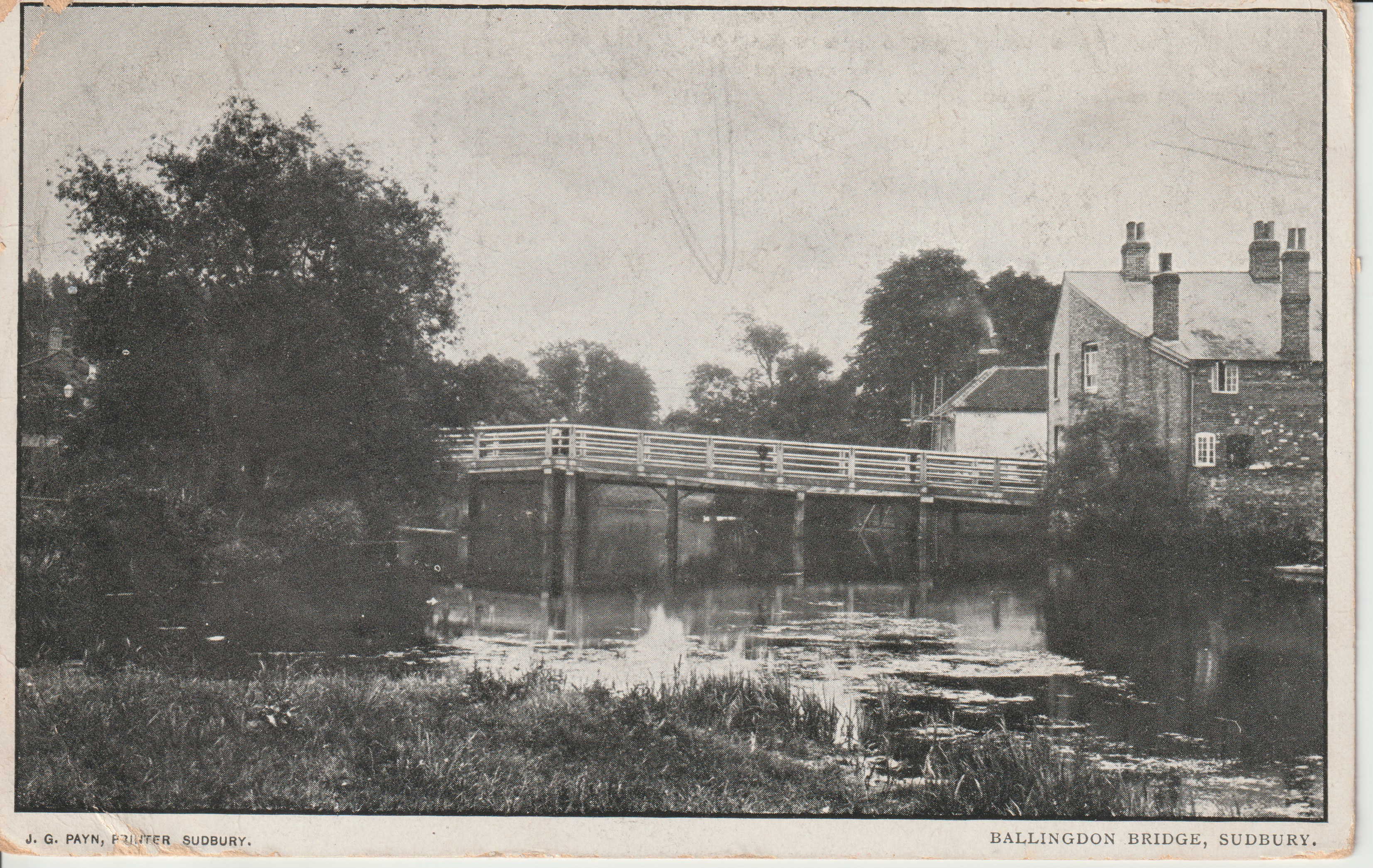
Ballingdon Bridge, Sudbury, England, ca 1911-1920s


This black & white, used, postcard has a cancelation but no complete date.  It features a photograph of Ballingdon Bridge in Sudbury, Suffolk, England.  J. G. Payn is identified as the printer at the lower left corner on the front of the card.  The card has a divided back and a green halfpenny stamp with the profile of King George V.  Most used postcards have had the stamps removed by stamp collectors.  As can be seen, the dark cancellation mark on this one dominates the stamp.  Maybe that is why it was left on the card.


Halfpenny stamp


The Ballingdon Bridge crosses over the River Stour.  The village of Ballingdon grew up adjacent to the bridge and is now in the parish of Sudbury.  The bridge dates back to the 13th century or possibly earlier.  The bridge is still the only crossing of the river for several miles.  The River Stour is 47 miles or 76 km long and forms most of the boundary between Suffolk on the north and Essex on the south.  In 1705 this river was one of the first improved waterways in England with mandated navigation rights. 


 Ballingdon Hall, a large house, was moved half a mile up Ballingdon Hill in 1972 when a housing development was being built near its original site.  The event was watched by 10,000 people.  There is a link below to a short YouTube video by Tim Leggett showing part of the move.  Coincidentally, the postcard is addressed to a Miss Leggett, Bridge House, Three Bridges, Sussex.


For additional information, see:


https://en.wikipedia.org/wiki/Ballingdon

https://en.wikipedia.org/wiki/River_Stour,_Suffolk

https://www.youtube.com/watch?v=1xM3XzFjoq4