Thursday, June 2, 2022

If this is Thursday it must be postcards, 558


Meerkerk Gardens, Greenbank, Whidbey Island


Meerkerk Gardens on Whidbey Island were another of the wonderful gardens that we hoped to visit someday.  That day arrived in mid-May.  It had been cold and rainy and not many flowers on the hiking trails yet, but still desiring to get out, Bob checked the weather forecast and we aimed for the best, sunniest day to take a long drive out and a ferry back.  What a wonderful surprise to find among the pamphlets and maps there was a postcard with this lovely view of the pathway and rhododendrons in bloom.  No photographer is credited with the picture, and the card has no publisher or distributor, suggesting that the postcards were printed for advertising purposes.  A donation fee of $5 per person is posted on the pay box found just outside the entrance to the gardens with additional donations appreciated.  Some of the proceeds from Washington State rhododendron vanity license plates also go to help support the gardens.


Sign pointing the way to the gardens


Entrance to the garden


These gardens were founded by Ann and Max Meerkerk in the early 1960s.  The idea and vision for a woodland garden came after they visited the Rothchild’s Exbury Gardens in England.  Ann was a member of both the Washington Park Arboretum and the American Rhododendron Society, Seattle Chapter.  Originally, the Meerkerks had 13 acres where they collected and hybridized rhododendrons.  Rhododendrons are Washington’s state flower.  The gardens were gradually expanded to 10 acres of rhododendrons surrounded by 43 acres of woodlands. 


Carved eagle on post


There are more than 1,500 varieties of rhododendrons and hybrids featured in the gardens.  Individual gardens blend together with signs to identify the areas by garden clubs or gardeners.  Throughout the gardens are wooden benches, some are plain others are decorated.  We also found a “Secret Garden” with fairies and in a different area a carved Eagle.


Fairy in the Secret Garden


The Gardens were bequeathed to the Seattle Rhododendron Society in 1979 for a “peaceful woodland garden with an emphasis on rhododendrons and companion plants.”


The working area with plants for sale


Today the gardens are open to the public and managed by the Meerkerk Rhododendron Garden nonprofit established in 2002.  There are over 4 miles of trails in the 53 acres of woodland gardens.  Special events held on the grounds include the Spring Nursery Sale, Mother’s Day Concert, and Octoberfest.


Some of the things we saw the day we visited.


For additional information, see:


https://en.wikipedia.org/wiki/Meerkerk_Rhododendron_Gardens

https://www.meerkerkgardens.org/history


Friday, May 27, 2022

One day, three short hikes, 2022


The beginning of the Taylor River trail is the remains of an old logging road.  It is fairly wide but extremely rocky as can be seen in the picture.  The trailhead is a short, rough drive with lots of pot holes, from the large Garfield Ledges trailhead.


One day, three short hikes:  Taylor River, Quartz Creek, and the Taylor River Connector to Middle Fork Snoqualmie.  The Forest Service Pass is required.  All three of these trails are close to one another.  We parked at the Taylor River trailhead for the first two and moved the car down to the Garfield Ledges trailhead parking area for the Connector trail.  There is a newer double outhouse privy at Garfield Ledges trailhead and a newer single outhouse at the Taylor River trailhead. 


Note:  Young children could easily do the short, level Connector trail which goes through woods and also has areas near the river with benches here and there that were carved out of downed trees.  The Quartz Creek trail is through woods but perhaps not as interesting.  Since it is a continuous up it might be tiring for young kids.  The Taylor River trail is extremely rocky and has creek crossings that might pose problems for younger children. 


This day started out with a plan to hike along the Taylor River for a couple of hours for a 4.5 or 5-mile RT with very little elevation gain, cross a few creeks, and see waterfalls.  We started out with hope but ended up only going part way, stopped by a creek that was too deep for us to cross without gators, fishing boots or water socks.  Younger hikers could and did cross, either by wading, or hoping rock to rock.  The water was running fast and cold over the rocks.  Our balance and rock hopping skills are not as they once were.   


Our turn around point on the Taylor River Trail.  It doesn't look too bad at first glance.  Bob walked out a little way and tested the depth with his foot and a trekking pole.  The water at the edge of the other side was deeper than the tops of our boots.  There were no good stable rocks to use as stepping stones.  


After much agonizing and analyzing the situation, we made the decision to backtrack and try the adjacent trail, Quartz Creek.   


The Quartz Creek trail is a steady climb up, and up, eventually reaching Blethen Lake.  The second half of the trail is a dotted line on the map = unimproved.  The lake was much farther than we wanted to go but we gained about 400 ft elevation before turning around and heading back.   


Quartz Creek trail is also an old logging road; however, it started out like this, broad and easy walking instead of rough and rocky. 


One small, pretty waterfall on the Quartz Creek trail


That did not seem like quite enough for one day so we took the Middle Fork connector trail from Garfield Ledges trailhead to the Middle Fork trailhead and back to Garfield where we had left the car.  


     Near the Taylor River trailhead, Bob standing by trees covered in moss


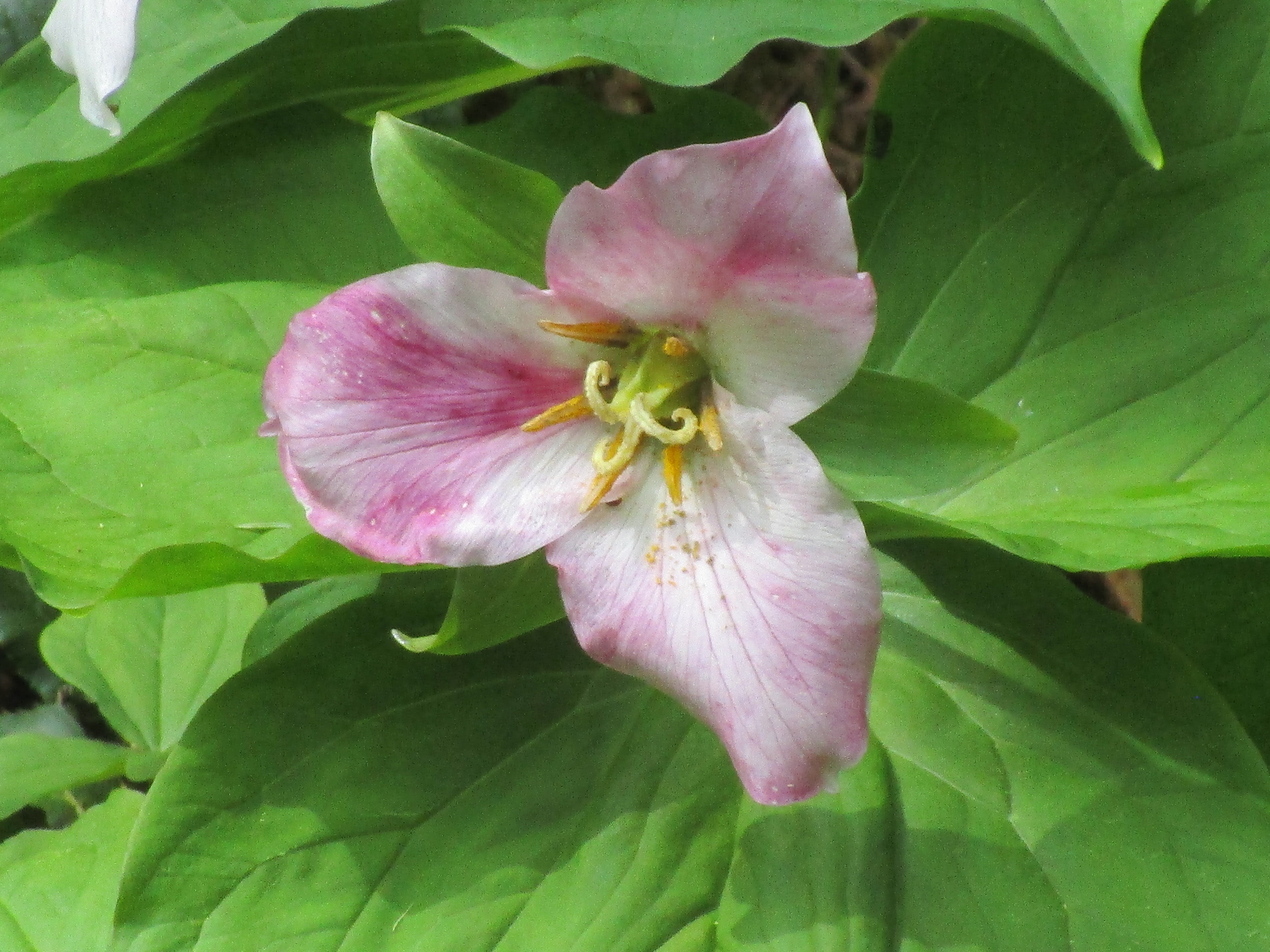
Trillium


Bleeding heart


Salmon berry


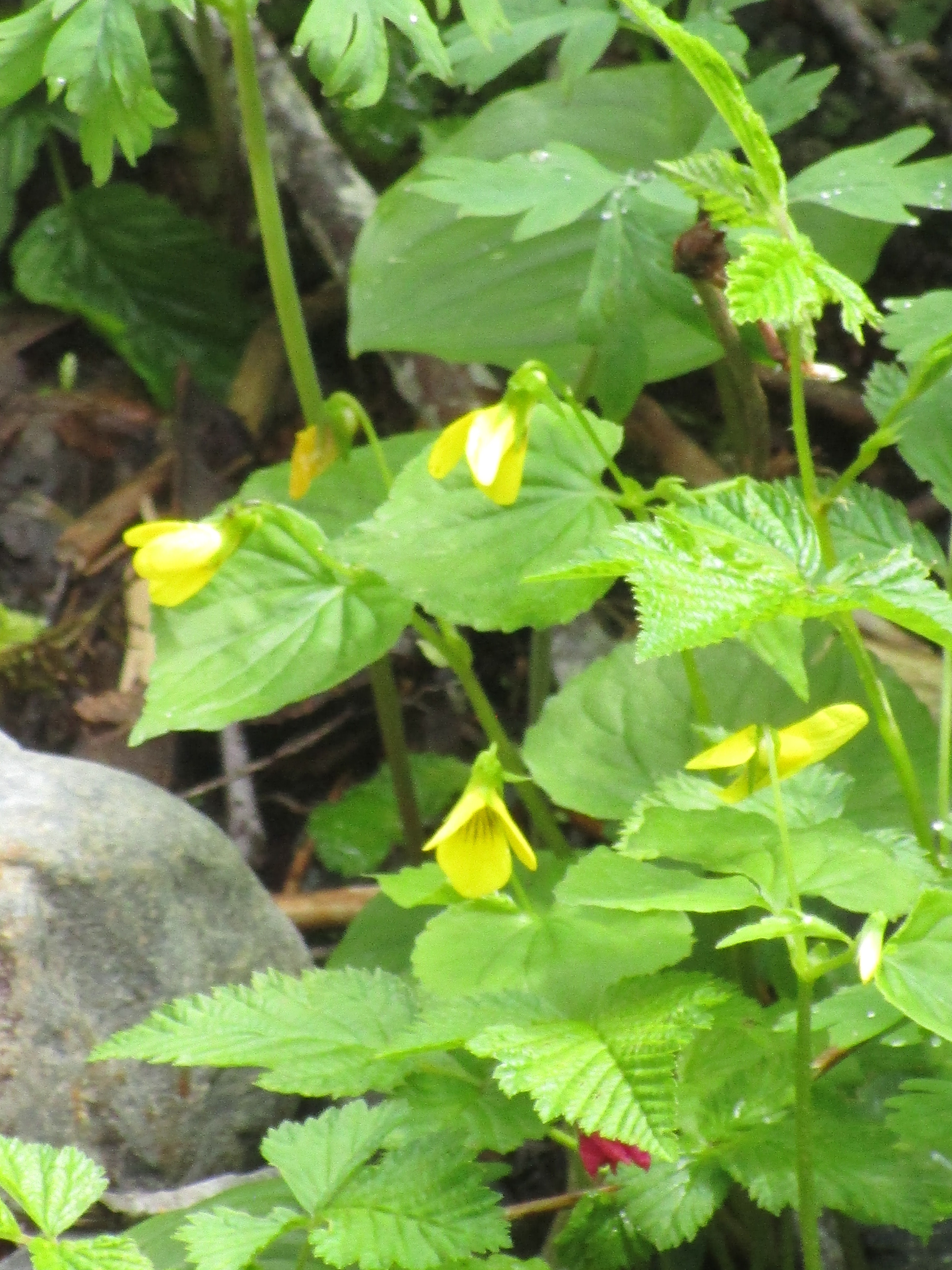
Yellow Stream Violets


Service berry aka Saskatoon


Bench and chair cut from downed trees along Taylor River Connector trail


Along the Taylor River Connector trail


The day ended with lunch in the car and a stop at Boehm’s Candy in Issaquah for much needed chocolate.  Total hiking distance for the day about 4 miles.


Count for the day, 5 hikers and two 12-year old Bassett hounds wearing GPS collars with antennae. 


I talked with the owner of the dogs and asked about the collars.  He had leashes but he was letting them walk leash free. He told me the dogs were old, slow, and sometimes would wander off.  Usually they would go together but once, before he had the collars, they separated and he couldn't find one of them.  He took the other dog back to the last place he had seen the dogs together and told her to find her sister.  Sure enough she sniffed around and trotted off successfully finding the other dog after a while.  To avoid a potential lost dog scenario the owner had found and read an article about the collars, ordered two, and now they both wear the collars whenever they are out walking.  The dogs were very well behaved nice dogs and that equals a good owner in my opinion. 


Thursday, May 26, 2022

If this is Thursday it must be postcards, 557


Edison Winter Home, Fort Meyers, Florida, Moreton Bay Fig Tree


Last week the postcard featured the Edison Winter Estate in Fort Meyers, Florida.  The card this week has a photograph taken by Ken Raveill of Terrell Publishing Co., and distributed by Edison-Ford Winter Estates Fort Meyers, Florida 33901.  The picture shows a giant Moreton Bay Fig tree with its monstrous roots.  On the card reverse at the lower left corner is 111.  At the upper left corner on the reverse is the blurb:  “Moreton Bay Fig Tree on the property line between Henry Ford’s home and Edison Winter Home…”  This card also was among those shared by K & J.


This large evergreen tree is commonly known as the Moreton Bay Fig or Australian banyan.  The Latin name is ficus macrophylla.  It is native to eastern Australia with its common name coming from Moreton Bay in Queensland, Australia.  It is best known for its imposing buttress roots.  Also called a strangler fig because the seeds germinate in the canopy of a host tree.  The seedlings are not parasitic but grow on the host tree until the roots contact the ground.  Once rooted in the soil it enlarges and strangles the host to become a free-standing tree.  They can reach 200 ft or 60 m in height.  The figs are exclusively pollinated by fig wasps.  Many different birds eat the fruit.  The aggressive root system and the eventual size of the tree make it unsuitable for most gardens.   


This tree has been cultivated in Hawaii and northern New Zealand where it has become naturalized.  It has also been used in frost free area public parks.  Because of its size and lack of natural enemies it is potentially an invasive species.


Thanks again to K & J for sharing the card.


For additional information, see:


https://en.wikipedia.org/wiki/Ficus_macrophylla


Saturday, May 21, 2022

Middle Fork Snoqualmie, 2022


Trailhead, Middle Fork Snoqualmie


We have hiked here several times.  It is a short walk from the trailhead to the bridge.  Once across the bridge the trail branches right and left.   


There was slide activity on the left hand, #1003 Middle Fork, trail beginning in 2019 and the next few times we came that side was closed and we went on the right hand, 1035 Pratt River Connector, trail instead.  This time the trail work on the Middle Fork side had been completed and the slide area had been stabilized.  It was open again and we decided to see what, if any, changes or improvement had been made.  This trail is open to bikes, hikers, and horses. 


We did not have a specific scenic view point or destination in mind but planned to hike for about 2 hours, find a nice place to take a break and then return to the car.  The original plan was about 4.5 miles RT.  Part of the new section of the trail is posted as narrow and steep. 


 When we got to the top of the posted steep section it was obvious that the trail led down in with an equally steep slope.  Nearing our 2-hour time and realizing that we would have to go steeply down and then back steeply up and steeply down again we decided to stop and make the crest our turn around place.  Going down can sometimes be more taxing than going up for legs and knees.  It was the correct choice for us as senior hikers.


Bleeding Heart


Fiddlehead fern


Salmon berry


Trillium


Indian Plum


Yellow stream violet


Coltsfoot


Skunk Cabbage


It is still colder than usual for this time of year, hence not too many things in bloom.  We saw skunk cabbage, salmon berry, Indian plum, trillium, bleeding heart, yellow violets, fiddlehead fern, star flower, and coltsfoot.  A fair number of trees had come down but had been cleared off the trail.  Lots of muddy spots, a little patch of snow, rocks and roots in places.  We both used trekking poles for part of the way.  Unfortunately, the cool weather did not deter the bugs.  I ended up with two applications of bug spray and even Bob, who is not usually bothered as much as I am, got a dose of repellent spray too.


Cairn


Once back at the trailhead we took a side branch trail toward the river, found a picnic table with a view, and had our lunch.  Some of the kids and adults we saw as we were returning also ended up at the riverside.  The kids built a couple of cairns.  This one was pretty impressive. 


Small patch of snow


 Mud


A daily fee of $10 or the Forest Service Pass is required.  It was not raining the day we were here but it had been raining off and on for several days.  The trail was quite muddy in several places.  In addition to the section posted as narrow and steep it is rocky and narrow near the beginning of the route alongside the river. 


Count for the day:  23 hikers including 12 kids, 1 dog


Thursday, May 19, 2022

If this is Thursday it must be postcards, 556


Thomas Edison Winter Home, Fort Meyers, Florida


Pictured is the winter home of Thomas Edison.  The photograph is by Ken Raveill of Terrell Publishing Co., and distributed by Edison-Ford Winter Estates, Fort Meyers, FL 33901.  The number 113 appears at the lower left corner on the reverse.  A blurb at the upper left corner reads:  “Some of the first prefabricated homes in America.  Built in Maine in 1885 and shipped to Florida on 4 sailing schooners.”  This card was included in the batch shared by K & J.


Thomas Edison first visited Southwest Florida in 1885 where he purchased property to build a vacation home.  The home shown on the card was completed in 1886 and named “Seminole Lodge.”  It was a place of relaxation and a winter retreat used by Edison until the time of his death in 1931.  Edison’s good friend, Henry Ford, purchased neighboring property, called “The Mangoes” from Robert Smith in 1916.   The Ford home was a craftsman style bungalow built in 1911. 


In 1947 Edison’s widow, Mina, deeded the Edison property to the City of Fort Meyers in memory of her husband for the enjoyment of the public.  In 1988 the adjacent Ford property was purchased and open for public tours in 1990.  Together these two estates now form the Edison and Ford Winter Estates.  In addition to Edison’s house is his botanical garden with more than 1,000 varieties of plants from around the world.  The garden features plants grown for industrial use, like bamboo used in light bulbs; and beauty, including roses, orchids, and bromeliads.  There is a moonlight garden designed by Ellen Biddle Shipman.  Edison did most of his research and work with exotic trees and plants while in Fort Meyers, Florida.  The rubber laboratory created in 1928, and the Edison Ford Museum are open to the public and offer a variety of programs and tours.  The Ford Estate was placed on the National Register of Historic Places in 1988 and the Edison Estate was added to the list in 1991.


Ellen Biddle Shipman (1869-1950) was an American landscape architect known for formal gardens.  Her gardens often appeared in magazines such as House Beautiful and House & Garde.  She was among one of the very few woman landscape architects of her time. 


Thanks to K & J for sharing the card.


For additional information, see:


https://en.wikipedia.org/wiki/Edison_and_Ford_Winter_Estates

https://en.wikipedia.org/wiki/Ellen_Biddle_Shipman