Thursday, November 18, 2021

If this is Thursday it must be postcards, 530


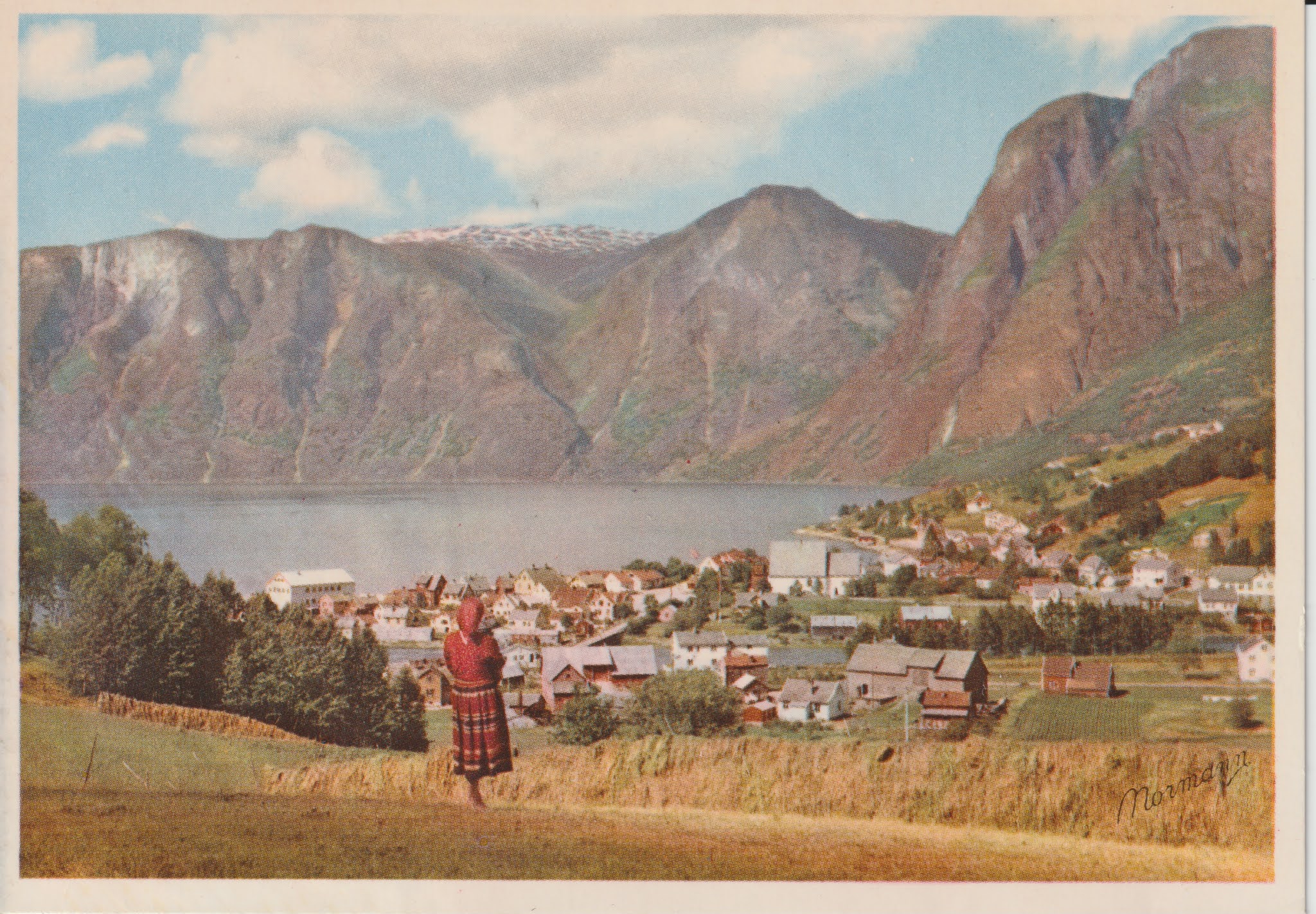
Aurland, Norway


This used Normann color photo postcard has the number 631 at the upper right corner on the reverse.  The picture shows the community of Vangen and the fjord.  When Dick Thompson and his sister Anna visited this area in 1951 they met with a cousin, Monrad Johnsen and his family.  Monrad sent this card with a Christmas greeting to Dick in 1958. 


Like many of the picturesque communities in Norway, Vangen is small, with the buildings clustered around the fjord and hugging the mountainsides.  The largest building in the center of the picture is the 800 year old Vangen church.  The style of the church is attributed to the English merchants who used to stay in Aurland for long periods to buy different goods and they helped build the church.  The building is described as an early Gothic style.  There have been several restorations with the most radical changes made in the 1860s.  The most recent renovation was in 1926.  The stained glass windows were made by the Norwegian artist, Emanuel Vigeland.  The pulpit and candlesticks date from the 1600s.  The church is open to the public with no fee.


Although it cannot be told from the picture on the card, the fjord is long, 18 miles or 29 km, and narrow with a depth of 3,156 ft or 963 m.  It is less than 2 km or 1.2 miles wide.  The mountains surrounding the fjord are steep, rising to about 5,900 ft or 1,800 m.  There are other villages along the fjord in small valleys.  Large sections of the fjord are part of the West Norwegian Fjords UNESCO World Heritage Site. 


Monrad Johnsen was the son of Eli Andersen Johnsen sister to Dick’s mother, Sigrid Berentine Andersdatter Thompson.  He was a teacher at the agricultural college in Aurland.  Dick noted in his Scrapbook that Monrad was awarded the King’s Medal of Merit during World War II.


Marie and Monrad Johnsen, 1955


For more information about Aurlandsfjord, see:


https://en.wikipedia.org./wiki/Aurlandsfjord

Thursday, November 11, 2021

If this is Thursday it must be postcards, 529


Caernarfon Castle, Wales, ca 1970s


This unused postcard features two photographs and written information about Caernarfon Castle, a medieval fortress, in Gwynedd, Wales.  It is another of the travel and information type postcards that has the blurb on the front of the card together with the pictures instead of a smaller blurb on the reverse sise of the card.  The card was printed in Great Britain by J. Arthur Dixon.  On the reverse, at the lower left cover is PGD25028.  This is another card shared by friends.


The Welsh Government’s historic environment service, Cadw, takes care of Caernarfon also spelled Caernarvon, Castle.  In the 1200s this was a motte-and-baily castle that King Edward I of England, began to replace with the current stone structure in 1283.  While the exterior looks mostly complete the interior buildings no longer survive.  Years between 1294 and 1415, the castle was sacked and besieged several times.  When tensions between England and Wales diminished, the castle was deemed less important and allowed to fall into disrepair.  “The castle was neglected until the 19th century when the state funded repairs.  It is part of the World Heritage Site “Castles and Town Walls of King Edward in Gwynedd.”


The Romans built the first fortifications at Caernarfon in the northwest part of Wales.  The Roman fort was named Segontium, and was located on the bank of the River Seiont, on the outskirts of the town.  The Romans left Britain in the 5th century so little is known about the nearby settlement.   


 Thank you K and J for sharing the postcard.


For additional information, see:


https://en.wikpedia.org/wiki/Caernarfon_Castle


Thursday, November 4, 2021

If this is Thursday it must be postcards, 528


Conwy Castle, North Wales, ca. 1970s


Here are another couple of castle postcards shared by friends.  The card above shows one angle of Conwy Castle.  This is an unused postcard by J. Arthur Dixon.  The picture shows the north front of the castle.  The card was printed by HMSO by W.S. Cowell Ltd., Ipswich.  P.4. appears at the lower left corner on the reverse. 


This castle was also built by Edward I between 1283 and 1289.  Part of the project included extending the walls to encompass the town of Conwy.  For centuries the castle and walls played important parts in wars, withstanding sieges, and providing safe havens.  UNESCO rates Conwy as one of “the finest examples of late 13th century military architecture in Europe.”  Conwy is also classed as a World Heritage site. 


Conwy Castle from the south, Gwynedd, Wales, ca 1970s


The second unused postcard has P.2. at the lower left corner on the reverse.  It is Hawlfraint y Goron card printed in England for H.M.S.O., Larkfield Printing Company Limited.


Forces loyal to Charles I held the castle in 1642 during the outbreak of the English Civil War.  The castle was surrendered to Parliamentary armies in 1646 and the castle was left slighted to prevent being used in any future revolt.  Eventually even iron and lead was stripped and sold off leaving it completely ruined in 1665.  In the 18th and 19th centuries it was a popular destination for painters.  As visitor numbers increased restoration work was carried out.  Today the ruined castle is managed by Cadw as a tourist attraction. 


Thanks K and J for sharing the postcards.


For additional information, see:


https://en.wikipedia.org/wiki.Conwy_Castle


Thursday, October 28, 2021

If this is Thursday it must be postcards, 527


Happy Halloween!  The cards shared this week are reproductions of Halloween greeting cards originally produced by the Beistle Company.  Laughing Elephant is a local shop that specializes in reproducing vintage art, cards, postcards, posters, and books.  The card above is stamped Copr. H.E. Luhrs on the Jack-O-Lantern’s cheek.  Below is another card from the same company, showing a black cat wearing a hat and a monocle with the same imprint on the bow tie.  


The Beistle Company or Beistle manufactures holiday decorations and party goods.  The company was founded in 1900 in Pennsylvania by Martin Luther Beistle.  A line of Halloween products was introduced in the 1920s and helped popularize Halloween decorations in the United States.  The company is still producing decorations and party goods today making it the oldest continuing manufacturer of such items.


Martin L. Beistle was working as a salesperson for the Pittsburg Art Calendar Company around 1900 when he had an idea to create artificial plants made from paper.  He started the company in his home basement where he made artificial flowers and wooden products.  The company expanded and was incorporated in 1907 and had moved from his basement to the second floor of a wagon shop in Oakville, Pennsylvania.  Eventually further expansion allowed the company to move to larger facilities in Shippensburg, Pennsylvania.  In 1910 Beistle was using imported technology and manufacturing honeycomb tissue, previously only available in Europe and Asia. 


In 1920 Beistle partnered with the Paper Novelty Company and began creating a variety of paper decorations for Valentine’s Day, Easter, Halloween, Thanksgiving and Christmas.  By this time the Beistle catalog had become popular and was best known for Halloween-themed items.  In the 1920s and 1930s fortune-telling games for Halloween parties were added.  Over 1,000 different Halloween-themed designs and decorations have been produced since the line was first introduced.  Creepy Company, founded in 2015, also offers apparel, pins, and other products based on the Beistle designs. 


After the death of Martin Luther Beistle in 1935 the ownership of the company passed on to his son-in-law Henry E. Luhrs and his family.  Since the cards shared have the Luhrs mark on them they were either reproduced from earlier cards or were new designs from 1935 and onwards.


For additional information, see: 


https://en.wikipedia.org/wiki/The_Beistle_Company

https://laughingelephant.com/


Thursday, October 21, 2021

If this is Thursday it must be postcards, 526


Snowdon [Yr Wyddfa] seen from Llyn Llydaw, Gwynedd, Wales, ca 1960s


Printed in Great Britain by J. Arthur Dixon, this unused postcard dates from the 1960s and is another card from the collections shared by friends.  PGD/23532 is found at the lower left corner on the reverse.  The subject of the photograph is Snowdon, or Yr Wydffa in Welsh, the highest mountain in Wales at 3,560 ft or 1,085 m above sea level. 


There are six main paths to the summit as well as the rack railway, Snowdon Mountain Railway.  The paths vary in difficulty, distance, and elevation gain.  The railway opened in 1896 and carries passengers almost 5 miles from Llanberis to the summit station.  At the summit there is a café that is open when the railway is operating.  The railway operates between March to the end of October, the running schedule depends on the weather and customer demand. 


The cliff faces on Snowdon are significant for rock climbing.  Before ascending Mount Everest in 1953, Edmund Hillary trained on them.  The rocks are the result of ancient volcanic activity and glaciation resulting in the pyramidal peak of Snowdon. 


The lake in the foreground is Llyn Llydaw.  It is a long narrow lake found about 1/3 of the way up the mountain.  Thousands of people visit Snowdon and walk past this lake each year.  Llyn Llydaw is the largest of three lakes found on Snowdon.  Water is piped from the lake to a hydro-electric power station below. 


A number of rare plants found on Snowdon led to its being named a national nature reserve. Established in 1951, Snowdonia National Park, provides some protection to the plants and animals. 


Snowdon and Llyn Padarn, Gwynedd, Wales


The second unused postcard shows Snowdon from another angle and another lake.  Llyn Pardarn is about 2 miles long and is an example of a moraine dammed lake.  This large natural lake links to a neighboring lake, Llyn Peris, and its water is also used for hydro-electric power.  Llyn Pardarn is designated as a Bathing Water and is open to recreational activities in the summer. 


 Thank you K and J for sharing the postcards.


For additional information, see:


https://en.wikipedia.org/wiki/Snowdon

https://en.wikipedia.org/wiki/Llyn-Llydaw


https://en.wikipedia.org/wiki/Llyn_Padarn


Thursday, October 14, 2021

If this is Thursday it must be postcards, 525


The Avenue at Middelharnis by Meyndert Hobbema, 1689


The unused postcard shared this week is art card with a painting titled, “The Avenue at Middelharnis,” by Meyndert or Meindert Hobbema, and dated 1689.  The original oil on canvas painting measures 40 3/4 inches by 55 ½ inches and is found in the National Gallery, London, England.  The card is numbered 1033 (830) at the lower right corner on the reverse.  It was printed in Great Britain for the Trustees.  This is another one of several cards shared by friends from an estate.  The card dates from the 1960s.


Meyndert, sometimes spelled Meindert Hobbema was a Dutch Golden Age landscape artist who was born in 1638.  He specialized in woodland views, although “Avenue of Middelharnis” is a slightly different scene.  It is notable also for being a very accurate depiction of a specific spot.  Looking closely at the lower right side of the painting it is possible to see a man tending the saplings.  The addition of a man working the land was unusual in 17th century Dutch landscapes.  Other figures are also discernible as well as known buildings in the background.  This is Hobbema’s most famous painting.  Hobbema was not well known in his lifetime but became more popular in later years.  Not all of his paintings are signed and some have been passed off as the works of others of the same time period.  He was married and had 5 children.  His wife died in 1704 and was buried in the paupers’ section of the Leiden cemetery.  Hobbema died in 1709 and was buried in the paupers’ section of the Westerkerk cemetery, Amsterdam.


Thanks go to K and J for sending the card.


For additional information, see:


https://en.wikipedia.org/wiki/Meindert_Hobbema

https://en.wikipedia.org/wiki/The_Avenue_at_Middelharnis

https://en.wikipedia.org/wiki/National_Gallery


Thursday, October 7, 2021

If this is Thursday it must be postcards, 524


The Ram Statue, Moffat, Scotland, ca 1960


Today’s postcard is one that falls into the category of informational.  The blurb is found on the front of the card next to the subject of the photograph.  In this case it is the Ram statute in Moffat, Scotland.  On the reverse of the card the number PT37058 is found at the bottom of the center line.  At the top of the line is DF 164.  The picture is credited to Photo Precision Limited, St. Ives, Huntingdon, Cambs.  It is a TextView Series card.


The town of Moffat is located 16 miles north of Lockerbie and about 59 miles or 95 km southeast of Glasgow.  It is held to be the ancestral home of Clan Moffat.  The sulfurous and saline spa waters were believed to have healing properties as early as 1633.  Later in the 1700s iron springs were added and the water was piped into a tank and on to a specially built bath house.  In the 1990s the old well was refurbished and is still accessible by vehicle and on foot.  The water smells strongly of sulfur. 


The Scottish sculptor, William Brodie (1815-1881), created the bronze ram commemorating the wool trade of the Moffat marketplace.  A local businessman, William Colvin, presented the statue to the town in 1875.  Trivia:  the ram arrived without ears and they are still missing.


Thanks again to K and J for sharing this card.


For additional information, see:


https://en.wikipedia.org/wiki/Moffat

https://en.wikipedia.org/wiki/William_Brodie_(sculptor)