Thursday, December 10, 2020

If this is Thursday it must be postcards, 481


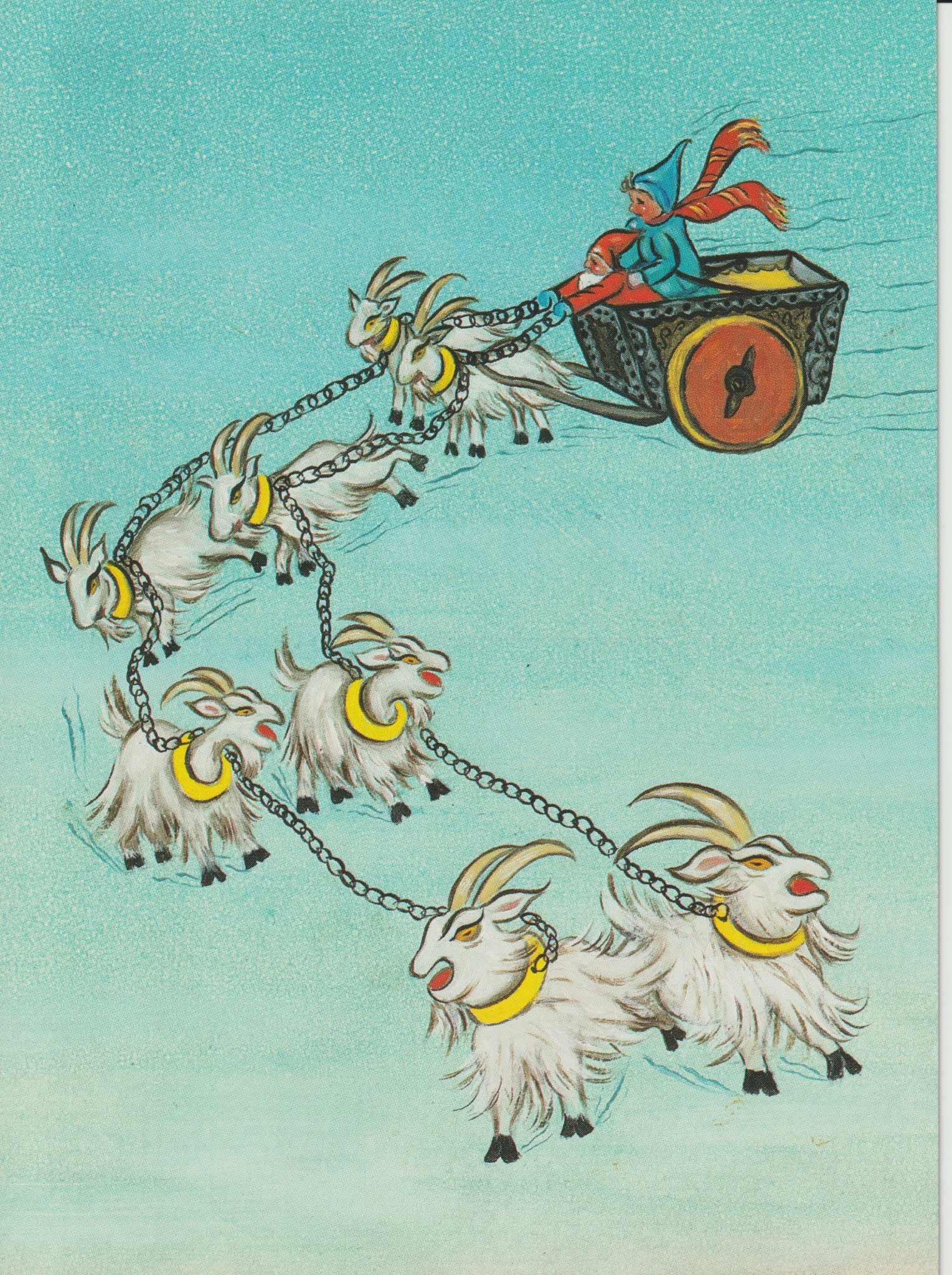
The goat chariot of Norse mythology, 1990

 [illustration by Norma Wangsness]


This unused postcard printed in 1990 by Penfield Press of Iowa City, Iowa, has an illustration by Norma Wangsness from the book Nils Discovers America by Julie Jensen McDonald.  Nils is the Norwegian nisse or elf-like being holding the reins in the picture.  The book is suitable for children ages 6 to 11 years of age.


The cart has 8 goats pulling it, a little bit like Santa Claus’s sleigh with 8 tiny reindeer.  Since it is getting close to Christmas eve and nisser are generally associated with Christmas, I thought I would share this card today. 


Prose and poetry versions of the myth were recorded.  In the myth there are only 2 goats who pull Thor’s chariot.  Their names are Snarler or Teeth Barer (Tanngrisnir) and Teeth Grinder (Tanngnjóstr).  The story about Thor and his goats was written by Snorri Sturluson and later compiled in the 13th century.  It can be found in the Poetic Edda.  Like a lot of Norse myths this one is a bit gory.  Every evening Thor cooks the goats for his meal and then resurrects them with Mjölnir, his hammer, the next morning.  The story continues with Thor spending a night in the home of a peasant and sharing his goat meal.  Thorn instructed the peasant and his children to cast the bones of the goats onto the goatskins that night but one of the children breaks a bone and sucks out the marrow.  This results in one of the resurrected goats becoming lame.  An enraged Thor sees that someone has mistreated the bones of his goats and threatens the peasant and his family.  The peasant begs for forgiveness and Thor keeps both children as his servants as restitution for the crime.   


In another poem these two goats are mentioned for their magnificent horns.  Thor is sometimes referred to as the lord of goats. 


For additional information, see:


https://en.wikipedia.org/wiki/Tanngrisnir_and_Tanngnjóstr

https://blogs.davenportlibrary.com/sc/2013/12/05/davenporters-...

https://www.iloveinspired.com/probituaries/norma-wangsness/


Tuesday, December 8, 2020

'Tis the Season -- for leftovers


This year Bob and I celebrated Thanksgiving for two instead of in our usual extended family group.  Because of COVID advisories we have been ordering our groceries delivered to the house.  Sometimes it is necessary to choose possible alternatives and sometimes we get really bizarre substitutions.  Nevertheless, we are thankful we have this option for shopping.  We ordered a turkey, within a pound range, and ended up with 14.4 lbs instead of 10 lbs.  That made for plenty of leftovers.  However, it was okay because we both like turkey and usually have it only once or twice a year.  In addition to the traditional Thanksgiving dinner we have made sandwiches, creamed turkey on rice, and put some in the freezer. My daughter-in-law S makes a great pot pie in a 9x13 pan with biscuit topping but we thought we would to try one with regular pie crust.  I was checking out all my cookbooks and couldn't find any pot pie recipes (after the fact I found one), so yesterday I made up this one and thought I would share it with family and friends.  I think this would work well with either leftover turkey or chicken.

Turkey, vegetables and gravy in the pastry lined pie pan
 

Top crust on and baked


Half eaten and the other half for the next night's dinner.


Chicken or Turkey Pot Pie                                                        preheat oven to 425F


Use your favorite double pie crust recipe

Roll out and fit the bottom crust in a 9” pie pan


Filling:

2 cups of leftover cooked chicken or turkey, chopped to bite sized pieces

1 large carrot, cut into bite sized pieces

1 large potato, cut into bite sized pieces

2 stalks of celery, sliced

1/3 to ½ large onion, diced

½ teaspoon salt

½ teaspoon poultry seasoning

Pepper to taste

1/2 to 2/3 cup of frozen peas

1 to 1 ½ cups of leftover chicken or turkey gravy

Note:  the filling should equal approximately 4 to 5 (or 6 cups max) of combined ingredients


1.  Boil the cutup carrots, potatoes, celery and onion in a medium saucepan with enough water to cover for 10 min.

2.  Meanwhile, reheat leftover gravy in a small saucepan.

3.  Drain the vegetables reserving the liquid in case you need to add some to the gravy

4.  In a large bowl mix the chicken or turkey pieces with the cooked vegetables, stir in seasonings, frozen peas, and the gravy.  Add a little of the vegetable broth if necessary.

5.  Pour the mix into the prepared pie pan lined with crust.

6.  Roll out the top crust and finish the pot pie crust just as you would a fruit pie.  Be sure to put the steam vents in the top.

7.  Bake at 425 degrees F for 30 min.  Increase the temperature to 450F and bake for an additional 10 min. or until the crust is golden brown on top.

Thursday, December 3, 2020

If this is Thursday it must be postcards, 480


The High Altar of the Avila Cathedral, Spain, ca 1963


This 1963 used postcard has a photograph of the High Altar area in the Avila, Spain Cathedral of the Saviour (Catedral de Cristo Salvador).  Located in the south of Old Castile, Spain it is a Roman Catholic church.  Printed on the reverse, the mid line and lower right bottom of the card, give Manipel as the distributor with Fournier – Vitoria . 


It is possible that there was an earlier Romanesque Church of the Saviour at this location and that work to build a new cathedral there began in 1091 by Alvar García.  What is known for certain; however, is that Alfsonso VIII hired the master builder, Fruchel, and initiated the construction of the present structure in 1172.  It is one of the first two Gothic style cathedrals in Spain.  Additional construction and modifications continued into the 1600s.  The enormous altar piece shown on the postcard was begun by the Spanish painter, Pedro Berruguete (ca 1450-1504), in the late 1400s and the beginning of the 1500s. 


Berruguete’s works include 8 images representing naturalism, and 2 boards portraying the “Prayer in the Garden” and the “Flagellation.”  He used gold backgrounds and the rigid compositions of the prevailing style in Castile at that time.  Berruguete died before the work was completed and his assistant, Santos Cruz, completed three works, “the Crucifixion,” “the Resurrection,” and “the Epiphany.”  The rest of the paintings are by a High Renaissance painter, Juan de Borgoña (ca 1470-1536).  He was known to use well balanced compositions with finely drawn figures in elegant and tranquil poses.  The scenes often included open spaces and craggy landscapes. 


Looking at the picture on the card one can notice the difference between the panels on the lower tier and the larger paintings with landscaped backgrounds on the two upper tiers.  “The Crucifixion” is the top center painting. 


The stamp features a picture of Francisco Franco who ruled Spain as a dictator from 1939 to 1975. 


For additional information, see:


https://www.avilaturismo.com/en/what-to-see/item/398-avila-cathedral 

https://en.wikipedia.org/wiki/Avila_Cathedral

https://en.wikikpedia.org/wiki/Pedro_Berruguete

https://en.wikipedia.org/wiki/Juan_de_Borgoña

Thursday, November 26, 2020

If this is Thursday it must be postcards, 479


Rosendal Palace, Stockholm, Sweden, ca early 1900s


This black and white used postcard has a picture of Rosendal Palace, Stockholm, Sweden and has the date 19 September 19?4 or ?7 (not legible).  Because the back of the card is divided and the message is written on the same side as the address, the date is probably at least 1904/07 and possibly 1914/1917.  The stamp was removed and along with it the cancellation place and date so it is not possible to be sure of the date.


Built between 1823 and 1827 for King Karl XIV Johan, the first Bernadotte King of Sweden, it is located on an island in central Stockholm.  It was intended as a retreat from the formalities of court life at the Royal Palace. 


The original Rosendal Palace, designed by Fredrik August Lidströmer, burned down in 1819.  Lidströmer created drawings for the replacement palace but Fredrik Blom, another leading architect of the time, was commissioned to build the replacement.  It is known as the Karl XIV style in Sweden.  With the creation of the replacement palace in the 1820s the area developed into a stately residential area.  In addition to the main palace there is the Queen’s Pavilion and the Guard’s Cottage. 


When King Oscar II died in 1907, his heirs made the Rosendal Palace a museum to the life of Karl XIV Johan.  Today the palace is open to the public during the summer months. 


For more information, see:


https://en.wikipedia.org/wiki/Rosendal_Palace

https://en.wikipedia.org/wiki/Fredrik_Blom


Thursday, November 19, 2020

If this is Thursday it must be postcards, 478


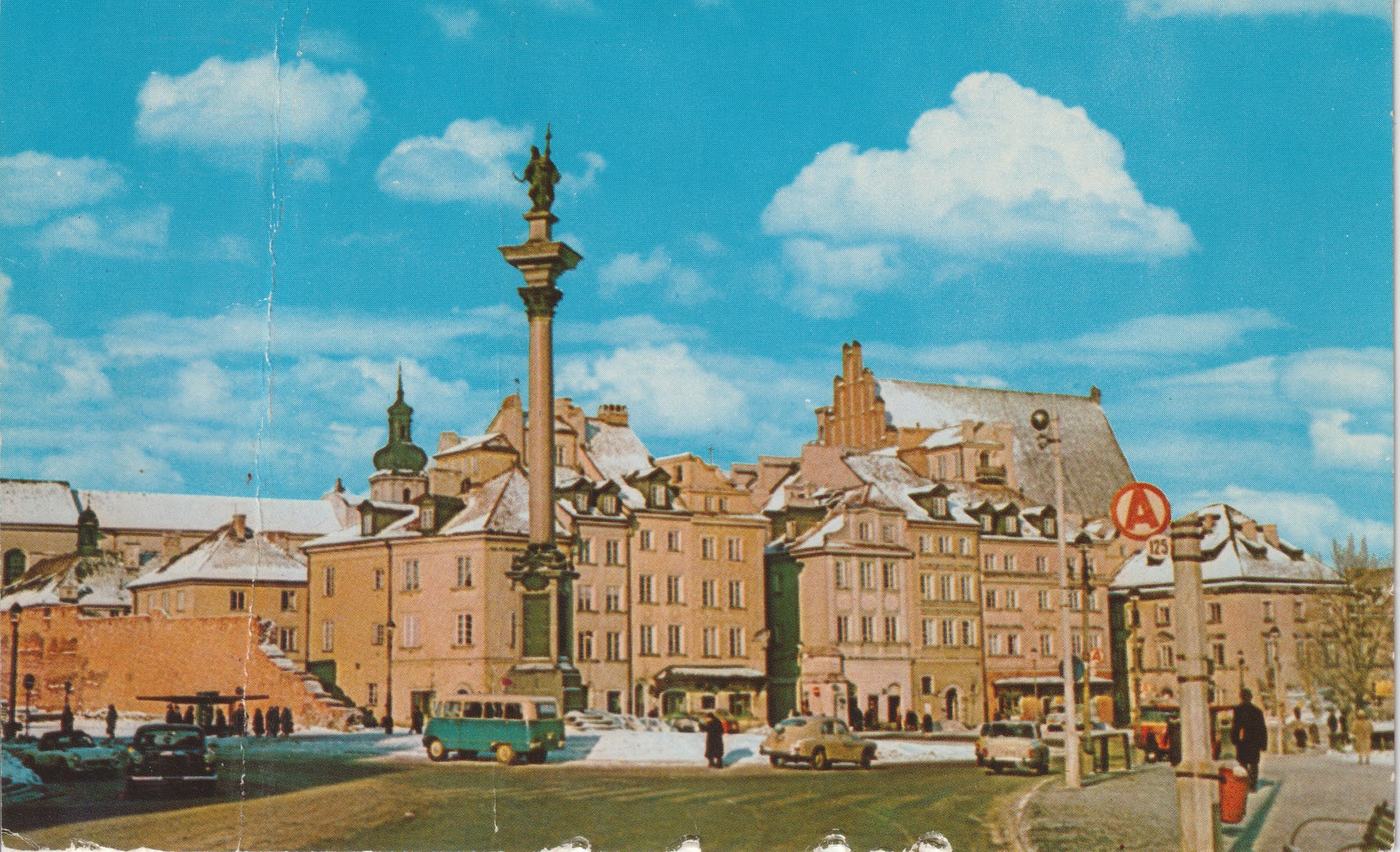
Sigismund's Column, Warsaw, Poland, ca 1950s


Dressed in armor with a sword in one hand and a cross in the other the statue of King Sigismund III Vasa stands atop a pillar in the photo on this unused postcard.  Wanda Tomcyzkowska is credited with the picture and the color card was produced by Mike Roberts of Berkeley, California.  The code, SC9945 is found at the lower left corner on the reverse. 


The original column was erected around 1644 in Warsaw, Poland under the orders of Sigismund’s son, King Wladyslaw IV Vasa.  In the beginning the column was 27 ft or 8.5 m high.  Today the entire monument stands 22 meters high or 72 feet tall.  The sculpture of the king alone stands 2.75 m or 9 ft tall.  The column from 1644 was made of red marble and was renovated several times.  A wooden fence surrounded the monument in 1681 and was later replaced with an iron fence. Then in 1854 a fountain was added.  A new column of granite replaced the marble column between 1885 and 1887.  Still later, around 1930, another renovation restored the monument to its original appearance and removed the fence and the fountain.  During World War II the bronze statue was damaged and the column was demolished.  After the war was over the statue was repaired and a new column made from granite was set up in 1949.  There is also a plaque with an inscription fixed to the pedestal.  The broken pieces of the original column can still be seen lying near the Royal Castle in Warsaw. 


The automobiles in the picture on the card suggest a date in the 1950s, which would mean the picture was taken not long after the 1949 repair work to the statue and the column replacement. 


For additional information, see:

https://en.wikipedia.org/wiki/Sigismund’s_Column

Thursday, November 12, 2020

If this is Thursday it must be postcards, 477


Temple of Olympian Zeus, Athens, Greece, ca 1960s


The photograph on this unused postcard is credited to the Greek National Tourist Office.  The card was distributed by Curteichcolor, 3-D Natural Color Reproduction.  The number 7 appears the upper right corner on the reverse.  There is also a short blurb stating “Temple of Olympian Zeus, Athens, was regarded as one of the wonders of the ancient world comparable to the pyramids.”


An open-air museum today, the temple ruins are supervised and protected by the Ephorate of Antiquities.  Construction on the temple began in 6th century BC. and was not completed until the 2nd century AD, about 638 years later due to interruptions in the construction.  At one point it remained in an unfinished state for over 300 years.  When work was resumed it was under the direction of the Roman architect Decimus Cossutius who made alterations to the original design and used expensive marble instead of local limestone as the building material. 


Once the largest temple in Greece, originally there were 104 colossal columns and one of the largest cult statues in the ancient world.  In the 2nd century Pausanias [in Description of Greece 1. 18. 6-9] mentioned the temple having a huge statue of the Roman Emperor Hadrian at the entry to the temple.  He also said this statue rivaled the colossi at Rhodes and described it as made of ivory and gold.  Additional statues made of stone, bronze, and marble were placed within the structure. 


  Glory was short lived; however, as it fell into disuse and was pillaged during a barbarian invasion in 247 AD.  Likely it was never repaired and was reduced to ruins.  After the fall of the Roman Empire the site was quarried for building materials to be used elsewhere in the city.  Sixteen of the original giant columns remain today.  It is still an important archaeological site in Greece. 


The temple ruins are located about 500 meters (0.31 miles) south-east of the Acropolis and about 700 meters (0.43 miles) south of the center of Athens, the foundations were laid on the site of an ancient outdoor sanctuary dedicated to Zeus. 


For additional information, see:


https://en.wikipedia.org/wiki/Temple_of_Olympian_Zeus,_Athens


Thursday, November 5, 2020

If this is Thursday it must be postcards, 476


Penang Skyline, Malaysia


This unused postcard with a photograph of the Penang skyline in Malaysia was distributed by S. Abdul Majeed & Co.  The number 100.208 is found at the lower left corner on the reverse.  The photographer’s name is not provided.

Penang is a state located on the northwest coast of Peninsular Malaysia.  The state consists of two parts, Penang Island, and Seberang Perai on the Malay Peninsula.  The capital city of George Town is located on Penang Island.  The island and the peninsula are connected by two bridges.  Penang’s population was listed as 1,767 million in 2018.  It is known as the Silicon Valley of the East.  

The name Penang comes from the modern Malay name Pulau Pinang which means in English, The Island of the Areca Nut Palm.  Seashells, pottery, hunting tools and other artifacts indicate that this area was inhabited 5,000 to 6,000 years ago.  In the 1770s the British East India Company formed trade relations in the Malay Peninsula.  In 1786 Francis Light negotiated a cession of the island to the Company in exchange for British military aid.  The island was then renamed the Prince of Wales Island.  Unfortunately, Light acted without authority and could not make good on the promise of military aid.  As a result, the British East India Company ended up settling with the Kedah Sultan by giving him an annual payment of 6,000 Spanish dollars.  

Light founded George Town as a free port with the aim of luring traders away from the nearby Dutch trading posts.  By 1826 Penang, Singapore, and Malacca were incorporated into the Straits Settlements with George Town as the capital.  Soon Singapore took prominence over Penang, even so, Penang retained importance as a port and was a major tin-exporting harbor.  Following World War II Penang merged with the Federation of Malaya, now Malaysia, which gained independence from the British in 1957.  Today Penang’s economy is primarily oriented to hi-tech manufacturing.

Francis Light was born in 1740 in England.  He had a career in the British Navy and was a colonial official who was respected by his British peers as a fair and honorable man.  He was admired for his achievements and was a skilled negotiator.  He cared for the welfare of the people and had rice sent to the people when the island was hit by a famine.  Light died in 1794 from malaria and is buried in George Town. 

For additional information, see:

https://en.wikipedia.org/wiki/Penang
https://en.wikipedia.org/wiki/Francis_Light