Thursday, October 11, 2012

If this is Thursday it must be postcards, 60


 Promenade du Peyrou 

Reverse side

Sometimes kind friends who know I like postcards send me cards and I really appreciate it when they do.  This one above shows Promenade du Peyrou, sometimes identified as Jardin du Peyrou, a park in Montpellier, France with the statue of Louis XIV prominently displayed in the center.  I think it a delightful scene as it includes the two elegantly dressed men wearing straw boater hats as they stroll along in the park.  These gentlemen also provide a perspective as to the size of the park and the statue of Louis XIV.  The other large structure is the water tower.   The photographer is identified at the lower left as L. J. Albaille of Montpellier.  Réunies of Nancy, France, printed the card.  A hat like this was popular during the early 1900s and considered formal summer attire for men. 

Below is a view of the park from a recent visit, complete with a small musical combo, a boy on a scooter, and people enjoying a day outdoors.  If you follow a line from the boy on the scooter to the left it is possible to see two figures that are standing approximately where the two men in the vintage postcard are standing.


Promenade du Peyrou
[photo:  courtesy of a Frenchman]

Although the message and the address are written on the reverse of the vintage card I found it interesting that the stamp has been placed on the front side upper left instead of the reverse side upper right.  This does not seem to have caused the post office any difficulty, however, as the stamp has been canceled and one presumes the card was delivered to the intended recipient.  Probably mail was hand canceled when this card was sent.  In today’s machine world I fear the automated canceller would have rejected it for not having the postage in the correct spot.  Then poor Rose at the cake shop would never have received the thoughts of Frederic!

Perhaps it is natural to jump from interest in the cards to the stamps, in any case, I do also enjoy the stamps and may from time to add some to these postcard posts.  It happened that I had another stamp like the one on this card and it does not have such a prominent cancellation mark, therefore, both are enlarged and displayed below.  A fun thing about the stamp on the postcard is that it was canceled in Montpellier, Hérault and that is where it was found approximately 100 years later.  Now it has traveled across the globe to end up in the United States.  Amazing.


The French painter (Paul) Joseph Blanc (1846-1904) designed and engraved stamps called “Type Blanc.”  The stamp above shows the Goddess of Liberty holding the balance of Equality with Fraternity depicted as two small angels.  Copper printing plates were made from engraved boxwood blocks.  Type Blanc stamps were first printed as flat sheets then later appear as rotary printing.  Beginning in 1900 this design was approved and the stamps were issued in denominations of 1c, 2c, 3c, 4c, and 5c with the 7 ½c released in 1926.  A 10c stamp was issued in 1929.  The color depended on the value of the stamp and this one that may have faded with time looks a shade of blue to me but was identified as green.  The design was used for a long enough period of time that these stamps can be found in flea markets and other places. 

For additional information about Joseph Blanc and the stamps please see:
http://fr.wikipedia.org/wiki/Joseph_Blanc_%28peintre%29
http://fr.wikipedia.org/wiki/Type_Blanc


Les Jardins du Peyrou
[photo by Jean-Luc Zaragoza]

The vintage postcard arrived in my mailbox accompanied by the card above showing an aerial view of modern day Montpellier featuring Peyrou park together with a letter containing additional information about both cards and the stamp.  From the view it is possible to see the symmetry of the park and its relationship to this section of the city.  The water tower looks larger and the statue pedestal looks much smaller—it is centered in the area with the trees.  The triumphal “golden” arch seen just at the upper middle left of the card balances the arched water tower.   The photographer is identified on the reverse as Jean-Luc Zaragoza, the card was printed by Meridionales and titled “Les jardins du Peyrou.”


…………………………………………………………..

Merci beaucoup!  J'aime les cartes postales, des photos et du timbre.  Merci aussi pour les informations intéressantes sur le parc et le timbre.
[Thank you very much.  I love the postcards, the photos and the stamp. Thank you also for the interesting information about the park and the stamp.]

Saturday, October 6, 2012

The maternal ancestors of Didrik Andreas Thomsen, part 2


Photo:  Didrik Andreas Thomsen as a young man

 
Please see the 24 July 2012 post for part 1 listing the maternal ancestors of Didrik Andreas Thomsen. 

Didrik’s mother was (I) Anne Didriksdatter the daughter of (II) Didrik Ånensen Dybvig (also spelled Djupvik) and (II) Gjertrud Marie Nilsdatter.  The previous post ended with Gjertrud’s parents, (III) Nils Tobias Pedersen Austad (born 1745) and (III) Anne Malene Jacobsdatter Nuland (born 1742 died 1782).  Today’s post begins with the parents of Nils Tobias Pedersen Austad. 


 [photo source:  Bygdebok for Nes Herred by Kaare S. Berg, p 119]


[photo source:  Bygdebok for Nes Herred by Kaare S. Berg, p. 20]

(IV) Peder Larsson Austad, born 1723 at Nes, Flekkefjord, Vest Agder, Norway the son of (V) Lars Pederson and Guri Jakobsdatter Osen.  Peder was married twice, first to Torborg Rasmusdatter Sunde who was the widow of Nils Ellingson Drangeid.  Torborg was born in 1712 the daughter of Rasmus Larsson Sunde and Todne Kristensdatter.  Peder and Torborg were married in 1744 at Nes.  Their children:

1.    * (III) Nils Tobias Pedersen, born 1745, inheritor of the farm
2.    Torborg, born 1748, died as a young child
3.    Lars, bron 1750, died as a young child
4.    Rasmus, born 1754, went to Holland in 1774, died unmarried, 1777
5.    Peder, born 1757, was living in Holland in 1777

Torborg Rasmusdatter Sunde died before 1765. 

Peder married second to Inger Hansdatter Lilledrange, born 1726, the daughter of Hans Tønneson Lilledrange and Anna Nilsdatter.  Inger Hansdatter was the widow of Tønnes Tjøstulfson lille Løyning a subdivision of Austad.  Their children:

1.    Tønnes, born 1765, died 1831
2.    Hans, born about 1768, inheritor
3.    Torborg, born about 1769, married Kornelius Korsmisson Netland

Inger died in 1775.   Peder was listed as lensmann or administrative official in 1770, he died in 1773.

(V) Lars Pederson, born about 1700 and died 1765, the son of (VI) Peder Larsson Gursli and Ingrid Pedersdatter.  Lars Pederson married first to Torborg Ånunsdatter Djupvik.  Torborg died 1737.  Their children:

1.    Marthe, born 1720, married Ole Ståleson Åsen
2.    * (IV) Peder born 1723, inheritor
3.    Helga, born 1729, married in 1755 to Sakarias Nilsson Ståby
4.    Anna, born 1733
5.    Birgitte, born 1737

Lars married second Siri Andersdatter from øvre Stølen in Herad, born 1685, died in 1755 at 70 years of age.  They did not have any children.

Lars married third to Guri Jakobsdatter Osen.  Their children:

1.    Jakob, born 1757, married Gjertrud Reidarsdatter Flikka
2.    Anne Berthe, born 1760, married 1787 Hans Hansson jr. Andabeløy
3.    Lars, born 1763

(VI) Peder Larsson Gursli, born 1670 and died 1728, the son of  (VII) Lauritz or Lars Jensson Hellesmark, Lund, and Ingrid Pedersdatter Gursli (no birth years given) who was the daughter of Peder Torgeirson Gursli, born 1622.   Peder married Helga Atlaksdatter Hove of Lund.  Peder is mentioned in Lund Bugdebok by Mehus; Kvinesdal Bydgdebok volume 1 by Årli, and Bygdebok for Nes Herred by Berg.  Peder and Helga had these children:

1.    * (V) Lars Pederson, born about 1700, inheritor
2.    Ingeborg, Pedersdatter,
3.    Ingrid
4.    Gjertrud, born 1709, married Oluf Osmundson Djubvik
5.    Birgitte

(VII)  Lauritz or Lars Jensson Hellesmark, born 1649, died 1728, married Ingrid Pedersdatter Gursli

(VIII)  Jens Lauritzon Hellesmark born 1616 died after 1700 married Bodil Lauritzdatter Bjerkreim the daughter of Lauritz Lauritzson Bjerkreim sokneprest in Lund, died 1640.

(IX)  Lauritz Knutson Øverland of Lund  (named 1635-45) married (given name not known) Jensdatter

(X) Jens Nilsson Hellesmark, (named in 1591)

(XI) Nils Hansson sokneprest in Lund, named in 1563, married Maren Jensdatter Hellesmark, named 1566-1590.

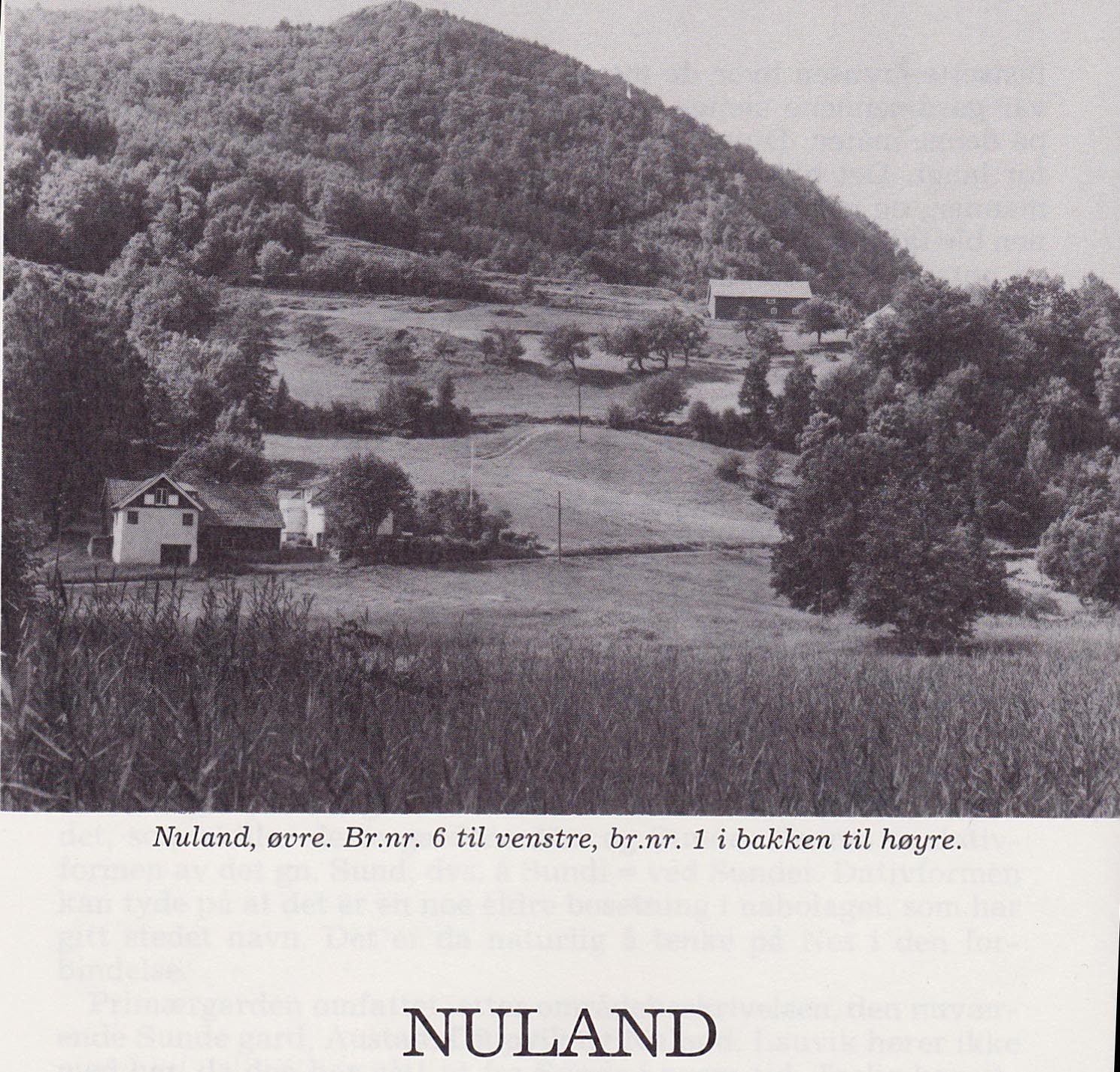
It is possible to also trace the extended additional female lines using Bygdebok for Nes Herred volumes 1-3 but I have only followed one direct line stemming from Didrik Andreas Thomsen’s mother’s mother, (II) Gjertrud Marie Nilsdatter.  Please see pp 120-127 of the aforementioned book series, volume 3.  At one time these farms were huge but over the years they were divided and re-divided until there were hundreds of small farms instead of the one large farm.  Austad had 116 divisions, Sunde had 360, Djupvik had 37, Nuland had 34.  I wasn’t able to tell if these divisions were larger than some of the others or if Djupvik and Nuland were just smaller areas in the first place.

Below are two maps.  The first one is a outline of the county or Fylke of Vest Agder, Norway and the second is a more detailed view of Nes Herred.  On the county map it is possible to see just how close this Thompson branch of the family was to the Hornnes branch.  It seems amazingly strange and wonderful that the descendants of these two families connected in America and probably never knew each other in Norway yet lived in fairly close proximity to each other.


Map of Vest Agder 
[source:  Genealogical Maps and Guide to Norwegian Parish Registers by Finn A. Thomsen]


More detailed map of Nes Herred, Flekkefjord, Vest Agder, Norway
   [source:  Bygdebok for Nes Herred, volume 1, by Kaare S. Berg]

Thursday, October 4, 2012

If this is Thursday it must be postcards, 59


 Østerbro Stadion, København, Danmark


 Reverse side of postcard

Axel Schroder received this card in January 1933 from Cathe Schroder as a thank you for Christmas and New Year greetings and reciprocal greetings back to Axel and his family.  Cathe’s handwriting is quite pretty.  It basically just wishes Axel and his family a good new year, thanks him for his long Christmas letter, mentions the new car and sends love and greetings to the family.  I think that is the general idea of the message but know I am missing parts of it.  If someone wants to translate the Danish for us that would be appreciated, as I am sure I didn’t get everything. 

The portal of the Østerbro stadion in København, Danmark on the postcard pictured above still exists but is no longer used as the entry.  The stadium was opened in 1912 and was the first sports stadium in the city.  The portal dates from 1926.  Both dates 1912 and 1926 are found in Roman numerals on the top portion of the entryway.  The original stadium architects were Arthur Wittmaack and William Hvalsøe.  It has been enlarged and revamped several times over the years since 1912 so that more sports fields could be added, dressing and changing rooms updated, additional grandstand seats, and clubhouse improvements could be made.  The stadium includes the outdoor facility for football (soccer) and five indoor venues for boxing, handball, table tennis (ping pong), martial arts and strength training.  In the basement there is equipment for weight lifting and general exercise. 

Several sculptures can be found on the stadium grounds including the two shown on the card.  “The Archer” by Ernst Moritz Geyger a German sculptor born in 1861 died in 1941 is mounted on a pedestal and centered in the entry on the postcard.  Geyger was a painter and etcher as well as a sculptor and the figure of the archer is prominent in his works.  Below is a close up of "The Archer."  For more information about Geyger see: http://de.wikipedia.org/wiki/Ernst_Moritz_Geyger


"The Archer" by Ernst Moritz Geyger

The second sculpture on the card is of three runners placed at the top of the entry.  It is titled “When the Target” and was created by Alfred Boucher a French sculptor born in 1850 and died in 1934.  There is a little more about Boucher at: 
http://en.wikipedia.org/wiki/Alfred_Boucher


"When the target" by Alfred Boucher


For additional information: http://da.wikipedia.org/wiki/%C3%98sterbro_Stadion

Thursday, September 27, 2012

If this is Thursday it must be postcards, 58


Stalheim hotel, near Voss, Hordaland, Norway
[postcard:  courtesy of Lorraine Becker]

In the 1950s when Dick Thompson went to Norway for a visit one of the places he stayed was at the Stalheim hotel near Voss, Hordaland, Norway, slightly north and east of Bergen.  The postcard above was one of those that his daughter showed me when I visited her a few weeks ago.  Rather like the Yvon postcards in France this one published by Ebern B. Opp has an identifying signature mark in the lower right corner.  Not many postcard publishers put their mark in this manner on the front of the cards as part of the picture the way an artist might on a painting.

The area pictured on the card is called the Næroy valley and is located between Voss and Gudvangen.  As I looked at the terrain surrounding the hotel it was difficult to imagine this as a postal farm or way station in 1647 but it was on the route that had just opened between Oslo and Bergen and therefore a rest stop much like the Pony Express stops in the United States.  Later an inn was built here in 1750.  That inn is now part of the Stalheim museum of antiques, artifacts, and art, one of Norway’s largest private collections.  A newer larger Stalheim Hotel pictured on the card was opened for business in 1885.  Unfortunately, in 1959 only a few years after Dick stayed here, there was a fire that destroyed most of the inn and resulted in the deaths of 34 people. 

A replacement was built in 1960 and is still a popular tourist hotel today.  An article I read said that since the early 18th century there have been many artists who have been inspired by the natural beauty of Stalheim.  One artist was J.C. Dahl who painted the romantically styled picture titled “Stalheim” in 1842 shown below.  The painting now hangs in the Norwegian National Gallery in Oslo. 


[* Artist: '''Johan Christian Dahl''' (Norway 1788–1857) * Title: '''Stalheim''' * Painted: 1842 * Oil on canvas. * The original painting is owned by Nasjonalgalleriet, Oslo.]

For additional information see: 

Friday, September 21, 2012

A fish story


 Joe's fish

As I was looking through some old photos I came across this one of the fish in the bathtub.  Then I remembered the episode and thought to share it.

Joe and Alice Huppman were neighbors and became great friends with my parents.  Every weekend we would have communal lunches with what my mother termed “smorgasbord” that meant a huge platter of sliced meats, cheeses, bread, and condiments.  Fix it yourself open-faced sandwiches with plenty of fruit, sliced vegetables and cookies too.  All four of the adults were coffee drinkers and the pot was on the stove all day long.  So, even though I do not drink coffee, the aroma of coffee evokes fond memories of my childhood home. 

The Huppmans had had a very interesting life.  Joe worked for the Ford Motor Company and had been stationed for most of his career in various parts of Asia.  I was never sure of all the places but I knew they had lived in Shanghai, China; Yokohama, Japan; and were living in Manila, Philippines, when the bombing of Pearl Harbor by the Japanese occurred in December 1941.  The Ford Company had already started evacuating employees and their families.  Alice was put on a ship but Joe was to stay a few more days to close up the dealership.  As her ship was pulling out of the harbor Alice watched in horror as planes began bombing Manila.  She described the black smoke billowing up out of the city as a scene from a nightmare.  She was to have no idea if her husband was alive or dead for two years.  Even though Joe was a civilian he was captured and put in a Japanese prisoner of war camp where he remained until 1943 when a group of U.S. civilian detainees were returned to the United States.  The only person Joe would ever talk to at all about any of his experiences when he was a prisoner was my Dad who seemed to be able draw out stories from everyone. 

Many of the other kids in the neighborhood were a little afraid of Joe because he seemed rather gruff.  He grew roses in his front yard and would get angry if kids or dogs or cats got anywhere near his beloved flowers.  Because of our close association with the Huppmans my brother and I were somewhat immune to the fear Joe inspired in the other neighborhood kids.  I remember liking both Joe and Alice and loving to go into their home where there were dozens of exotic souvenirs from their travels and Alice let us play with many of small figurines that were displayed on shelves in the living room. 

Joe was an avid fisherman and my Dad had done his fair share of fishing as well so we were regaled with fishing stories from time to time.  Joe and his brothers and friends would go to Neah Bay where one of them had a fishing boat or would charter a boat; I’m not sure which it was.  Salmon fishing was the objective.  Usually Joe would come back and tell my Dad about the one that got away.  The size of the fish grew with each telling and conjured visions of a mammoth sized fish in my mind something on the order of the biblical story of Jonah and the Whale.  These stories were always accompanied by a great deal of laughter by both my Dad and Joe. 

One afternoon, while my Dad was still at work, Joe returned from one of these fishing trips and came to the house looking for my mother.  He was very excited and wanted to surprise Dad.  Joe said he had got the fish and he wanted to put it in our bathtub so that when Dad came home from work and was cleaning up for dinner he would be confronted with the fish.  I’m not sure how they managed it but between them, Joe and Mom got the fish in the tub, took the picture, and then packed the fish in ice to keep it cold until it could be properly admired and then cut up to eat or freeze.   I measured the length of the bathtub, the inside measurement is 4 feet!  That fish filled the entire tub end to end.  I have no idea how much it weighed.  It had been cleaned but the head and tail had been left on for the viewing.  Now as an adult I think it a pity that it wasn’t caught during a Salmon Derby, as it should have won a prize for the biggest fish.


Dad & his fish at Ratz Harbor, ca 1930s


Dad was a great outdoorsman.  He had plenty of his own, sometimes hair-raising fish stories.  In this picture above we see him at Ratz Harbor, Prince of Wales Islands, Alaska with two fish he caught. 

Dad was tall, 6’ 2,” so the fish in the photo are large but still not as large as the one Joe caught that ended up in the bathtub.  To Joe’s never-ending delight it had the desired surprise factor, Dad was astounded when he saw it.  There was much laughter and exclamations of amazement at the size of that fish.  I think it was the best fish that didn’t get away story ever.

Thursday, September 20, 2012

If this is Thursday it must be postcards, 57

California Building, Alaska Yukon Pacific Exposition, 1909

 Many of the buildings on the grounds of the Alaska Yukon Pacific Exposition of 1909 reflected cultural heritage.  For instance, the buildings for both Japan and China were designed to look very much like they stepped out of those countries.  The Hoo Hoo House and the Arctic Brotherhood buildings were built of timber from the northwestern United States.  Live exhibits such as the Igorrote and Eskimo Villages were built to allow the visitors to feel as if they were in actual native villages.  The California building shown on the postcard above has a decidedly Spanish appearance, as did many places in California at that time and still do.  This building is quite different looking than other buildings on the fair grounds. 

Among the exhibits the interior housed displays of fruits, nuts and vegetables that were grown in California.  We are fortunate that a couple of photos of the interior views are still available that show the often creative and spectacular displays.  Oddly the interior does not appear to reflect the Spanish theme of the building exterior.  It is hard to imagine why a model of an animal like an elephant made of fruit or nuts would seem appropriate but perhaps it was just for the artistic novelty and to attract visitors to the display with a sort of awe factor.  The glass jars and round bowls filled with produce look like penny gumball or candy machines.  Gumball machines were first introduced in 1907 so it is possible that in 1909 it would have seemed a fashionable or novel way to display items such as these in that manner.


Interior display, California building
[photo:  Frank H. Nowell, photographer]

Interior display, California building
[photo:  Frank H. Nowell, photographer]

The official photographer for the Alaska Yukon Pacific Exposition of 1909 was Frank H. Nowell (1864-1950).  Many of his pictures, like these above, were on display during the Fair and also used in official publications.  Born in New Hampshire he moved to Alaska at age 22 to join his father who was involved in mining near Juneau.  He took up photography as a hobby taking pictures of the native Alaskan people, businessmen, city officials, railroads, hydraulic mining, waterways, ports, and creating a visual record of Alaska around the turn of the century.  He traveled between Nome, Alaska and Seattle and around 1908 J. E. Chilberg, the president of the Exposition, appointed him as the official photographer.  After the Fair he operated a commercial photography studio in Seattle for 25 years. 

For more information about Frank H. Nowell and his AYPE collection see:
http://nwda-db.wsulibs.wsu.edu/findaid/ark:/80444/xv75935/

Tuesday, September 18, 2012

Torkjel Mikalsen Hornnes, Update

 Torkjel (Torkild) Mikalsen Hornnes
[photo:  courtesy of Alf George Kjetså]


Torkjel Mikalsen Hornnes (1871- 1924) the fifth child of Mikal Alfsen Hornnes and Anne Gundersdatter Uleberg, worked as a foreman at the Vennesla aluminum factory.  Recently we have located more photographs, some from the Vennesla postcard club, of the company town in Vigeland and I thought it might be interesting to post them.  It gives us a better idea of where and how he and his family lived.  The first two pictures below are aerial views showing the layout of the town and the location of the railway station.  The third photo is of Rødbyen or Red City where he lived.


Smia, Liebermanns første bygg, arbeiderboliger, spisebrakke, rødbyen formannsboliger  [Forge, Liebermann’s first building, workers housing, dining hall, Red City, foreman’s housing]
http://www.venneslafrimerke.no/postkort/bilde.php?seksjon=vikeland


Jernbanestasjonen [Railway station] at Vigeland
http://www.venneslafrimerke.no/postkort/bilde.php?seksjon=vikeland


Rødbyen as it is today.
[photo:  courtesy of Rune Jensen]

The company built the houses for the employees; the red duplexes were housing for the foremen, the white fourplexes were for other workers.  From the photos it looks as if the white houses were separated from the red houses by the rail line.  Torkjel and his family lived in one of the red houses.  The company houses were said to have been a high standard with reasonable rent for the time period.  It got its name, Rødbyen, or “Red City” from the color of the houses.  Most of the white houses are now gone but parts of Rødbyen” are still there.  In addition to the forge and houses there were a post office and a grocery. 

Below is an early photo of people waiting at the train station at Vigeland.  Notice all the books or cards displayed in the windows of what looks to be the ticket kiosk.  There is a railroad employee standing in his brass buttoned uniform.  There is even a black dog near one of the small girls.  Judging from the skirt lengths it would appear that the photo was taken around 1915.


Aluminum production requires a lot of water, which may be partly why this area was selected for the factory.  The aluminum produced at this factory was labeled “super pure” and 100% recyclable.  Pulp factories for paper manufacturing also require water and that type of industry is found here as well.  Wallboard manufacturing is found here too.  Below is a picture postcard showing the waterfalls at Vigeland.


Torkjel was said to have died in 1924 as a result of a brain tumor and to have had up to 50 or more operations.  Rune Jensen told me that the number of operations seems to increase with each telling of the story though, so it is not really possible to discern the absolute truth at this time.  This story a good illustration of oral family history stories in that things change with each telling.  It is just something that we need to be aware of and accept.  There is generally a kernel of truth with the oral histories but many of the details get distorted with time and re-telling. 

Torkjel’s widow, Ingeborg, took work at the factory in order to keep the house after he died.  She later remarried to Olav Dallen.  Several descendants of the family still live that general area.

Thanks again to Rune Jensen for helping with the family information and photos.  


 ............................................................
 Note:

There was a recent family gathering of Torkjel's descendants at Dallen that Rune attended.  He sent some photos and if I can gather enough additonal information or stories there may be another update in the future.