Thursday, May 10, 2012

If this is Thursday it must be postcards, 38

 The raising of the Norwegian flag at Bergen 10 am on the 9th of June 1905.

Norwegian Constitution Day is May 17th so I thought I would share this postcard.  This occasion marks the first time the flag for the newly independent country of Norway was flown in Bergen.  Christian Michelsen is pictured in the inset.  He was a shipping tycoon from Bergen who became the leader of the coalition government in March 1905.  Another statesman, Jørgen Løvland, comes from Evje og Hornnes, Aust Agder, Norway and I do have biographical information about him that I will post separately. 

From the 1400s to 1814 Norway was under the Danish crown and from 1814 to 1905 it was under the Swedish crown.  The year 1905 marks the separation from Sweden.  At the Karlstad Conference the two countries were separated without coming to blows and without the loss of life.  That stands as a shining light of Swedish and Norwegian history – indeed for the entire world.

Belle Homsher recalled a little song that was popular in Bergen in 1905 about Michelsen.  She sang it for me and I transcribed it as it sounded so it may not be exactly right.  If anyone has heard it and is familiar with the words, please let me know so I can make any corrections. 

“I nitten hundre og fem
var Svenska nok så slem
hvem der var Kristian Michelsen som tam’d dem
Du ma høyliget for mannen
Som si her og her”


I think it says something like this in English--


“In nineteen hundred and five
Sweden some say was so bad
It was Kristian Michelsen who tamed them
You must give honor to the man
Some say here and here”


Christian Michelsen and Jørgen Løvland at the conference table, Karlstad, Sweden, 1905

Wednesday, May 9, 2012

Bergliot becomes Belle -- Journey to America

Hands across the sea

 Belle [Bergliot Elida] left Norway in early April of 1911 to come to America.  She was 14 years old traveling with her father, Bertel Ananias Berentsen and her stepmother, Anna.

I asked her if she was excited to come to America.

“Oh yes.  I was.  To begin with I was very excited to get to come to America.  But I had a cat at home called “Munce.”  I didn’t like to leave my cat.  And when we were on the boat coming over here I was crying and you know how kids are.  And my dad said, “What are you crying about?”  “Oh,” I said, “I wish the doctor would find something wrong with me so he would send me back to Norway.”  He said, “Why do you want to go back to Bergen?”  “Well,” I said, “I want to go back to my cat.”  [Belle laughed.]  My cat meant more to me.  He was such a cute cat.  We used to go play hide and seek at home.

“We came on a ferry steamship across the North Sea into Hull, England.  From there we went by train and boat across the Atlantic in through Canada.  We came in to Canada.  But I don’t, you know, when you are 14 years old you don’t pay too much attention when you’re not interested in scenery or anything.  And . . . when we came into Vancouver, Canada, in the late afternoon and we just missed a train to go to Seattle.  So my dad, he went down and he found out there was this boat leaving.  That was a Princess boat, and so we left, he got us on there, and we got in the next morning at 10, no 8 o’clock.  So, we traveled at night.  And they were surprised when we came.  They expected us the night before.  They were down to the train to meet us but we didn’t come.  My brother (Birger) left that morning for Alaska.  So we didn’t get to see him.  He had that job* to go to in Alaska and he had to get going.  So we didn’t see him until he came back, say in October or late in September. 

“We had family in America.  My brother was here, Birger.  Birger Amungus.  Funny names they had back in the old country.  Hmmm, Mrs. Landaas, Karen Landaas, she was here.  She had a sister here, Gurine.  But I never met her.  She passed away before we came over, it seemed like it.  I don’t remember.  But I know they used to go and see him (Gurine’s husband).  Tryg did anyway.  That’s the one they called “Saude.”  They always called him Saude.  It was a funny name.  The Landaas family, they were great for making up names.  I guess you heard that.  They always had names for everybody.  Different names.  They were very nice.  Sigrid . . . she was Taxi or Tax.  That’s what Harry called her.  And then it was Tryg and then Nora.  They were a pretty good-sized family.  Adolf, Cornelius and Harald and Tryg, that was four boys.  Maggie, Klara, Petra, Sigrid, and Nora.  That’s a big family and to all come over.  In those days the fare was very reasonable, but even so, the wages were smaller too.  So it was just about the same as now, we just had to skimp and scrape to get along. 

“I had to learn to read and write in English, you know.  So I went to a school in Ballard.  They put me in with younger children and I didn’t like that.  Now, I can hardly talk Norwegian.  I could if I had Norwegian people to talk to.  It takes a little time to think about it.  I was trying to tell Jack (her husband) every once and a while what they call this and that in Norway.  I always thought I’d like to take a trip back.  And my son, I don’t remember what year that was; it was before I married again.  You see I was a widow for 18 years between Jack and my other husband.  Let’s see, Frank passed away in 1947 and we got married in 1965.  Him and I.  So, you see that was about 18 years.  So I was going to go and take a trip to Norway.  I belonged to the ladies chorus and I thought, well, they had a tour going so I signed up for it.  But I didn’t, I backed out.  I’ve never been back. 

I have a cousin, you know, he was just a little child.  He was about 2 ½ or 3 years old when we left Norway and he is here in the United States.  Otto was his name.  He was my stepmother’s nephew.  And I call him once in a great while, and he said he goes back every so often.  He said, “You wouldn’t even know the place.”  He said, “If you came back to the place where you lived it’s altogether different.”  It’s so different that he doesn’t even enjoy going any more.  But he has a sister living there.  But they were a big family.  I think there were 11 or 12 kids.  And so he, but there’s only one of them left and that’s Klara.  And she was about 4 or 5 years old when we left.  So she’s the only one and she lives in Oslo.  She is a trained nurse.  She married a captain--ships went back and forth.  They don’t have any children, so she is all alone.  She’s the only one who is living, the only one of his family left.  So he used to go back there quite often.  I don’t think he’s gone back lately; he’s not too good either.  He’s about Jack’s age, about 83.  A youngster.  We’re all youngsters.  I’m the old lady.  (Belle was 93 at the time.)

To be continued.


..............................................................
 Note:

* Birger worked in the canneries in Alaska and later on the ships that went up and down the coast from Alaska to Seattle and further south.  He often shipped out of Vancouver, British Columbia, Canada.  

Monday, May 7, 2012

Update: Thomas LeRoy Ford

Thomas LeRoy Ford

There have been a couple of people who have indicated interest in the Ford branch of the Lorig family hence this update is about Thomas LeRoy Ford (aka Lee Roy or Uncle Tall Ford) who was born 6 May 1855 in Trenton township, Henry County, Iowa and died 13 February 1916 in Henry County, Iowa.  Lee Roy Ford was married three times, first to Ellen M. Crouch in 1878, second to Margaret Mae “Maggie” Lorig in 1883, and third to Laura Moore in 1906.  He was later divorced from Laura.  He had seven children with Maggie but no children are listed with his other two wives. 

Six of the seven sons of Thomas LeRoy Ford
[oldest to youngest:  Ralph Henry, Ray James, LeRoy Albert, Earl Marion, Ellis Fernando, Charlie Harold.  Not pictured Guy Lee who died as an infant]

Ellen Crouch Ford died at age 17 in 1879.  She is buried in Old Richwoods Cemetery, Trenton Township, Henry County, Iowa.  The gravestone gives her birth year as 1862.  It was originally thought that she was born and lived in Iowa but I recently learned that she and her sister, Dora Ann, may have possibly have been born in Ohio.  Ellen’s mother was Rebecca Guyton.  When Ellen’s father died Rebecca took her two children by John and perhaps some children from her first marriage and moved from Cedar County, Iowa to Henry County to be closer to her family. 

I did find a John Crouch born in 1828 in Ohio, living in Green, Harrison, Ohio in 1850, the son of Levi Crouch born about 1783 and his wife, Mary born about 1793.  Children in the family at the time of the 1850 census* were Mary, age 24, John, age 22, William, age 20, and a Mary Lyons age 15.  Her relationship to the family was not provided.  I also found Civil War draft** information on John who was drafted into the Union Army in July 1863.  At the time of the draft he was living at Springfield, Cedar County, Iowa.  The next step will be to see if Rebecca received some type of Civil War pension because I think it likely John died either during the Civil War or shortly thereafter.  Ellen was born about a year before John entered the army. 

Rebecca Guyton (alternate spelling Guiton) was the daughter of Samuel Guyton born 1782 and died 1844 and Ann Chance born 1784.  Samuel and Ann were married 21 December 1808 in the First Methodist Episcopal Church, Baltimore, Maryland.  The children of Samuel and Ann were:  Dorcas, born 1800, died 1878; Elisha born 1807 died 1891; Mary Ann born 1814 died 1874; Rebecca born 1822 died 1907; and Nancy born 1830 died 1904.  Dorcas married John Wesley Ford who was the uncle of Thomas LeRoy Ford. 

Rebecca was married three times, first to Joseph Keesecker in 1844 with whom she had the following children:  Tabitha Ann, born 1845, died 1924; George born 1847 died 1910; Lucy A. born 1849; Mary born 1850; Eliza Jennie born 1851; Joseph born 1853.  Joseph Keesecker was born 1823 and died 1853.  John Crouch was her second husband they had two children:  Dora Ann and Ellen.  Her third husband was James Mitts.  They married in November 1871 in Henry County, Iowa.  No children are listed for the third marriage.  If there are Ford family members reading this who have corrections and/or additional information that we can add to this family group I would appreciate hearing from you. 

If I find out more I will post another update. 


………………………………………………………….
Note:

*  Source reference for 1850 Census, Green, Harrison County, Ohio, NARA M432, page 234B as found on Ancestry.com
** Source reference for Civil War Draft Registration, NM-65, entry 172 as found on Ancestry.com

Additional  information such as names & dates compiled from Foard, Forde, Ford by Helen Ford Gisser, Ancestry.com and FamilySearch.org

Baby blessing day


Yesterday was the big day.   T-Bone wore her beautiful blessing gown, had pictures taken, and had a full house of family there to celebrate with her.  Pretty baby dressed like a princess.


We had to spread her out on the lawn in order to get the entire length of the gown in.  The baby only fills up about one half of the dress!  Mrs. Gimlet and Curly's mom did an incredible job making it.  It is just so lovely. 

Closer view of the Hardanger lace on the edge of the dress.

Curly, Bee and Baby makes three.


"Are you done taking pictures now?"

Friday, May 4, 2012

Bergliot Elida Berentsen, Belle -- remembering her early years

Bergen, Norway ca 1900

I visited Auntie Belle several times in her home and on one occasion I took a tape recorder.  Belle was almost 93 years old at that time and lived into her 100th year.  She passed away 14 April 1997.  She was rather proud of her longevity remaining spry and cheerful to the end.  She had lost considerable eyesight but still managed to get around fairly well.  She laughed about how she sometimes was surprised at what she had picked up at the grocery store, as she couldn’t see well enough to read the labels on the cans.  She was great fun to visit. 

Here is a little background to place her in the family.  Belle was born in Bergen, Norway on 28 September 1896.  Her Norwegian name was Bergliot Elida Berentsen however that was changed to Belle when she came to America.  She was the youngest of the three children born to Bertel Ananias Berentsen and Elen Nikoline Ingebrightsen.  Her brothers were Ingvald Kristofer Berentsen, born 8 January 1886, and Birger Amandus (sometimes written as Amungus) Berentsen, born 29 December 1893.  Ingvald remained in Norway but Birger came to America with his aunt Karen Landaas in July 1909.  Not quite two years later in April 1911 Belle left Norway at age 14 with her father, Bertel Ananias (Uncle Nias) and her stepmother, Anna (Tante Anna).  Nias was a half-brother to Karen Landaas being the child of her mother, Kristi Mor, and her mother’s second husband, Berent Berentsen.  I so wished I had a picture of her but Belle had had a facial palsy as an adult so she was self-conscious and would not let me take any photos of her. 

I asked her about her life in Norway. 

“I was born in Bergen.  I was there until my mother passed away.  And I was 2 ½ years old when my mother passed away.  I was born in Bergen and I was baptized in Johannes Kirken in Bergen and I was confirmed for Laksevag.  That’s right across from Bergen.  Then after my dad remarried, then we moved out to the country, you see.  My dad was a seaman.  So he wasn’t even home.  He didn’t come home until about six months after my mother passed away.  Well, we had an aunt living out in that neighborhood of Haakonsalle, and she, she was the one who tried to . . . and I guess my aunt here in America, tried to get us distributed around.  My aunt, Mrs. Landaas, Karen Landaas, she lived in Bergen.  She went over and looked in on my mother when she was sick in bed for a while.  Then she had a little help.  And my oldest brother, he was the one who took care of us kids and the house.  So he wasn’t very old.  He was only 13 years old.

“And I had another brother, younger.  But he was 2 ½ years older than I was.  I was the youngest one of three.  So we were three kids.  So then one was placed in one family.  My oldest brother lived with my aunt out for Haakonsalle.  But I was put over in Alvern (Alvøen) to a lady; she had another little girl my age, a little older than I was.  For about six months until my dad came home.  And then he had to find another place for us kids.  So he had to, he got busy and he met this lady.  That’s where she lived, that’s where her folks lived, out there.  Up for Haakonsalle, that‘s what it’s called now.  Haakonsalle.  That’s about a mile, seven American miles from Bergen.  Like from Ballard to Seattle.

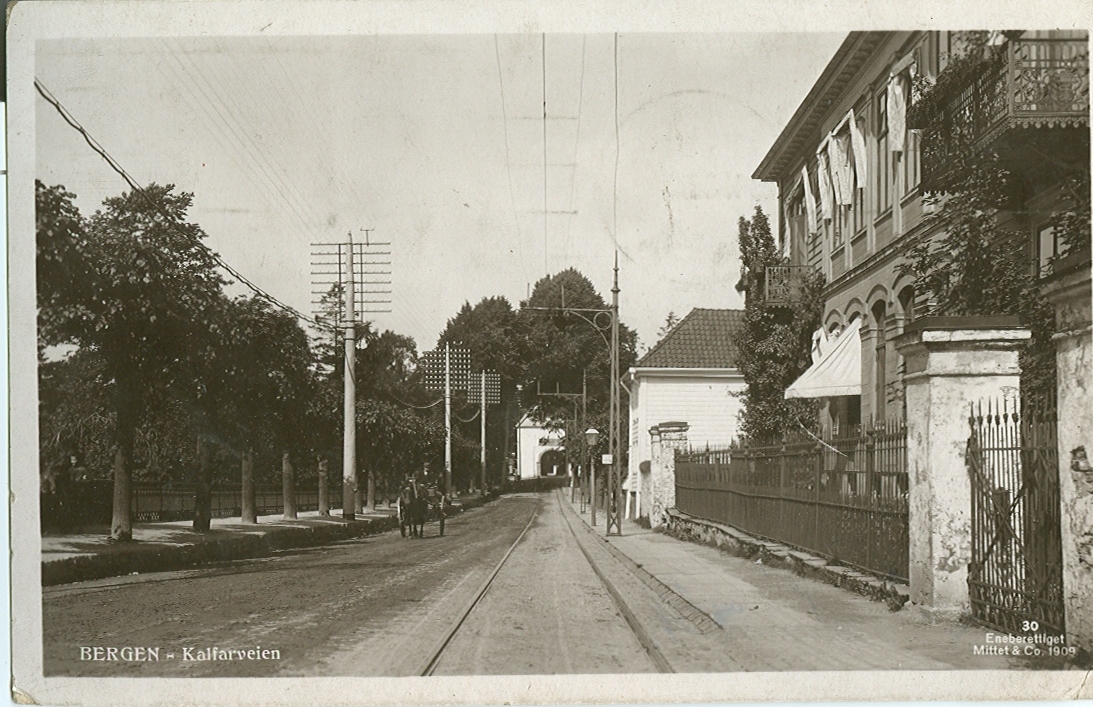
“My dad was the half-brother of Karen Landaas.  My grandmother, she married again.  Her name was Olsen, I think, when Karen Landaas and them were born.  But he is a Berentsen.  And that was my grandmother’s name.  She lived at the Frue Enkehus in Bergen.  All the old women lived there when they got older and couldn’t take care of themselves.  Frue Enkehus in Bergen. 


Kalfaveien, Frue Enkehus,* Bergen, Norway, ca 1900

“My grandfather, I think he drowned.  He was a “fløtmann” they called it in Bergen.  A fløtmann, that’s the same as carrying, as had a boat and carrying people.  A ferryboat, like.  But it was just an ordinary rowboat, I think.  And he drowned; I think that’s the way it happened.  It’s quite a long story.


“Anyway, they didn’t have a place to leave us.  All three kids were in different places when my dad came home.  So then he had to get us together to find somebody who would take care of us, all in one place.  So he found this lady and about a year later, I guess, they married.  They married in 1901, the 15th of January 1901.


Tante Anna,** ca 1910

“Then we lived with another family till after my father came home and they got married and got settled and then they rented a place.  A room, that’s all they could get.  Until they got their house built and moved in.  And so we lived . . . let’s see, her folks owned a big farm up for Lindaastjerne, that was the name of it.  And her folks owned that farm, but he had just turned it over to his son.  You see, the oldest one, back there, was supposed to have the farm and the others just got a little plot for their house.  So she had a sister, another sister, my stepmother, and she got a plot over on the east side where he (the brother) lived.  The grandfather was in the middle and we got a plot over on the west side overlooking the bay.  It was really nice.  We lived in a really nice place there.  That was a very pretty inlet there where we lived.  Very beautiful.  We could stand outside of our window and wave to the ships.  My dad, if he were on the boat coming into Bergen then they always tooted the horn when he came in.   And when he left they did the same thing.  Because if you went south, and he had to go that way to get out to the North Sea across to the other countries.  We lived there until I was 14 years old.  I would be 15 in September.  We came to America in April and I would be 15.  So I was 14 years old when I left Norway. 

“My grandmother, Kristi Mor, she used to come out and visit us.  I always remember that because I was just a youngster, you know, and she used to use, have snuff.  That was supposed to be good for her asthma.  I guess it was asthma she had.  She put a little bit up in her nose, in her nostrils.  And we used to think that was so funny!  But back there, you know, we went to visit some other older, my stepmother’s older relations.  They lived way up by the ocean, up close by the North Sea.  And they used to smoke, that, what do you call them, clay pipes.  And, you know, us kids, when you’re kids you get a kick out of just about anything.  You think that’s so funny.  So that’s the way it was, but I remember my grandmother using that snuff.  But it wasn’t very much. 


“She had a skaut.  That’s what they call it in Norway.  It was wired, I guess, or a frame or something.  I don’t know just how it was.  Oh you know, I wish I had a picture of it so you see it. “


Later I did find this photo of Kristi Mor wearing the skaut and dressed in a traditional everyday type costume.  


Kristi Mor wearing a skaut

To be continued.

………………………………………………..
Note:

*  I am not absolutely certain this is the Frue Enkehus but it seems like one of the older relatives told me at some time in the past that it was.  If anyone reading knows more, I would appreciate hearing from you.

**  As a small child I was enchanted and fascinated by Tante Anna.  She was so very tiny, dressed in black, and was 101 years old!  I remember seeing her at Aunt Wilhelmina’s house for some sort of Landaas family gathering.  I was quite young.  My grandmother was not quite 5’ tall, yet Tante Anna was smaller.  Like my grandmother, Tante Anna, liked to wear necklaces and bracelets.  She was an altogether delightful little lady.  She was almost the size of a child.  All the older relatives fussed over her quite a bit too.  It may have been her birthday.

Thursday, May 3, 2012

If this is Thursday it must be postcards, 37

Le Palais du Luxembourg, ca 1900

I thought it might be interesting to compare these two pictures, one taken around 1900 and the other in April 2012. 


Le Palais du Luxembourg, 2012

Completed in 1631 this building was once the royal palace until the Revolution.  At various times it has been used as a prison, headquarters for the Luftwaffe during World War II, bomb shelters were under the gardens and it is now used by the French Senate.  It is located inside a large lovely park on the Left Bank called the Jardin due Luxembourg.  The park was not too far from our hotel and we walked through it on our first day in Paris.  There are two other parks to the south that are only separated by the streets so it is an immense green area altogether.   The gardens are all symmetrical with the trees cut in precise lines—rectangles, circles, and triangles and several statues and fountains.  Every shape is symbolic, the triangle points to heaven, the circles represent the eternal nature, and the rectangles order in the world.  One of the parks was a “nature or natural park” but it was as planned and orderly as the others.  Pleasing to look at, restful even, but to me they all show that man made them and seem like gardens more than parks.  It was interesting and quite different from the nature parks and wildlife preserves we have here in the US.  
 

Looking toward the Jardin du Luxembourg


Pond in the Jardin du Luxembourg.
 
Children often sail small toy boats in the pond although the day were there we did not see any doing so.  As in most of the parks we visited there are statues along the walkway.  Part of the Eiffel Tower can be seen in the background.


Looking from the Jardin du Luxembourg toward the Jardin des Grands Exploratuers


Fountain in the Jardin des Grands Explorateurs

Tuesday, May 1, 2012

Paris, France snippets . . . Eiffel Tower

 
Eiffel Tower

No trip to Paris would be complete without a visit to the Eiffel Tower.  My camera battery gave out the evening we were atop the Arc de Triomphe so unfortunately I didn’t get any good shots of the Eiffel Tower in her evening gown (with lights).  However I did get two daytime photos that I liked.  This one in soft color that shows the whole tower and the one below that shows some of the ironwork closer up.  Our guide explained that the people hated the tower when it was first built.  A group of artists even petitioned the city to have it removed describing the Tower as looking like an “ugly iron smoke stack” complaining that it was so tall it took away from the beauty of the other attractions in the city.  The writer Guy du Maupassant would dine in the first level restaurant in order to avoid having to look at the tower. 

The public worried the tower would rust but mostly it was thought to be ugly and possibly dangerous since it was so tall.  The Eiffel Tower was the tallest building in the world until 1931 when the Empire State Building was completed in New York City.  It was supposed to be torn down after the Universal Exhibition (World’s Fair) of 1889 of but by the end of the allotted time the people had changed their minds and the tower remains as one of the iconic symbols of Paris.  Mrs. Gimlet got a stunning night picture (see http://gimletblog.com/2012/04/25/france-2012-amuse-bouche-seven-super-shots?owa_medium=feed&owa_sid= ).

When we were there the elevator up to the first landing was being serviced and not in use.  There are 360 steps to get to the second elevator and over 1,600 steps if one were to climb all the way to the top and not use an elevator.  We did not have any takers for making the climb that day but I think some of the students may have gone back later on their free time. 

Eiffel Tower, close up  

The complex pattern of girders was necessary to stabilize the tower in high winds. There are two restaurants, one on the first level and the other on the second level.  Over 200 million people have visited the tower since it was built.  From “Eyewitness Travel, Paris” p. 195 some trivia facts:  “the tower is 1,065 feet tall including the antennae; the top can move in a curve of 7 inches under the effect of heat; there are 1,665 steps to the third level; 2.5 million rivets hold the tower together; the tower never sways more than 2.5 inches; the third or top level of the tower can hold 800 people at one time, the tower weighs 10,100 tons; and 60 tons of paint are used every seven years” to beautify and protect the structure from rust.  The Eiffel Tower was last painted in 2009-2010.  Our guide said it takes about 18 months to paint the tower.  The tower is lit at night plus there is a show of spectacular twinkling lights that lasts for 5 minutes and is repeated on the hour from dusk to midnight.  We saw it.  Like 4th of July fireworks here in the US, it perhaps has to be seen in person to get the full effect.  Thing One did take a short video of the sparking lights and there are several clips on YouTube such as this one: http://www.youtube.com/watch?v=nTaq_MI6ey8.  Enjoy.